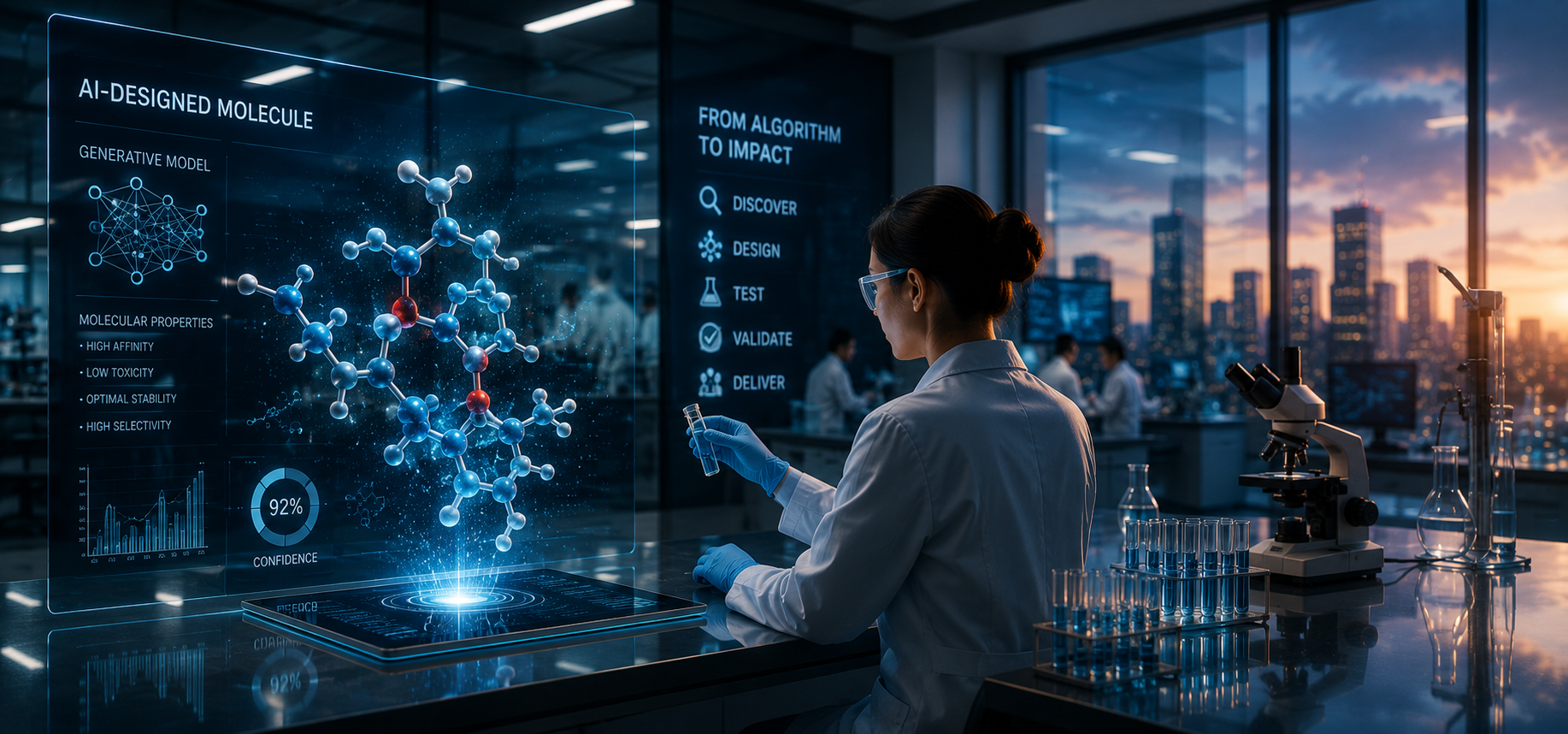
For a decade, AI drug discovery sold itself on speed. This year, the first AI-designed molecules reach pivotal Phase III, where speed has never been the thing that kills a drug. The patent cliff means the industry can no longer afford to look away from the answer.
The pitch for AI in drug discovery has always been a stopwatch. Faster target validation. Compressed medicinal-chemistry cycles. Molecules designed in months that used to take years. The marketing has been so relentlessly about velocity that the industry seems to have forgotten a basic fact about its own economics: speed is not where drugs die.
Roughly nine in ten drug candidates that enter clinical testing fail. They do not fail because chemists were slow. They fail in patients, in Phase II and Phase III, when a molecule that looked elegant on a screen turns out to be unsafe, ineffective, or both. That is the real bottleneck, and for years AI has been busy optimizing the part of the process that was never the problem.
In 2026, that gets put to the test. The most advanced AI-designed drugs are entering pivotal trials, with multiple clinical readouts expected through the year. For the first time, we will have data on the only question that matters: does designing a molecule with AI make it more likely to survive the clinic, or just cheaper to fail there?
Speed was the easy part
Give AI its due. It has genuinely changed the front end of discovery. Generative models propose viable structures faster than human teams. Target identification that once took a department now takes a cluster. These are real gains, and they are not in dispute.
But notice what they have in common. Every one of them improves the cheap, fast, early stages of development. None of them touches the expensive, slow, late stages where capital actually burns and programs actually collapse. A faster discovery engine feeding into the same brutal clinical failure rate produces one reliable outcome: more shots on goal, with the same miss rate, arriving at the goal mouth sooner. That is not a cure for the failure rate. It is a more efficient way to encounter it.
If AI only makes discovery faster, the industry has bought itself the ability to fail sooner and at lower cost. Useful. But that is risk management dressed up as a revolution.
The cliff that forces the question
Pharma cannot treat this as an academic debate, because the clock is loud. Around $300 billion in annual revenue loses patent protection by 2030. That is not a distant cloud; it is a wall, and it is pushing capital hard toward late-stage, de-risked assets while accelerating M&A and reformulation across the sector.
Here is the squeeze. Conventional reformulation, the textbook tactic for extending a franchise past expiry, takes two to three years of iterative experimentation. The expirations landing in 2026 through 2028 do not leave that runway. So the playbook is already shifting to consolidation: buy the late-stage pipeline you cannot grow in time, because organic chemistry runs slower than the patent calendar. AI's promise of faster target validation and shorter chemistry cycles is, in theory, exactly the tool for a sector that has run out of time.
In theory. Whether it works depends entirely on what those Phase III readouts say, which is why 2026 is less a milestone than a verdict.
Figure — Where AI helps vs. where drugs die
Development stage | Does AI clearly help? | Where the real failure risk sits |
|---|---|---|
Target identification | Yes — faster, broader | Low cost; failure here is cheap |
Molecule design | Yes — generative gains are real | Low cost; speed has always been fine |
Preclinical | Partially — better triage | Moderate; some failures caught early |
Phase III | Unproven — first readouts in 2026 | Highest cost; ~90% of clinical failure lives here |
How to read it: Read the second and third columns together. AI's confirmed wins (top rows) sit exactly where development is already cheap and fast. The capital-destroying risk sits in the bottom row, where AI's contribution is still a hypothesis awaiting data.
What this means for leaders
Judge AI partnerships by clinical evidence, not discovery throughput. Vendor decks will keep counting molecules designed and weeks saved. Those are inputs. The output that justifies the spend is a higher clinical success rate, and until a Phase III demonstrates it, treat throughput claims as cost savings at the cheap end, not value creation at the expensive one.
Plan the patent cliff as if AI will not rescue it. The $300 billion exposure is certain; AI's clinical payoff is not. Build the M&A, licensing, and lifecycle strategy on the assumption that organic discovery, AI-accelerated or not, will not outrun the expiry calendar. If the readouts surprise to the upside, that is found money. Do not budget for it in advance.
Watch the 2026 readouts as a portfolio signal, not a science story. The first positive AI-designed Phase III will reprice the entire category, and the first high-profile failure will do the same in the other direction. Either way, the data lands this year. Have a thesis ready before the print, because the market will not wait for you to form one.
The industry spent ten years celebrating a faster path to the same cliff edge. In 2026 it finally learns whether the new tools change where that path ends, or merely how quickly it gets there. That answer, not the speed that preceded it, is what will decide whether AI deserves the word "revolution" or just a line in the efficiency budget.
A BusinessInfomatics original. Drawn from 2026 pharma and AI-drug-discovery analyses by Drug Target Review and DrugPatentWatch, plus patent-cliff reporting.