
Expansion revenue from existing customers costs seven times less to generate than equivalent new logo revenue. Net Revenue Retention above 120 percent compounds faster than any new logo strategy. The arithmetic is unambiguous. Most B2B companies are still treating the function responsible for these outcomes as a cost centre.

Sales · Business Infomatics Research Desk
The growth model that defined the SaaS industry from roughly 2015 to 2022 was built around a specific assumption: that the market for new logos was large enough and accessible enough that the primary lever for compounding growth was the rate at which you could acquire new customers. Expand the sales team, increase the marketing budget, drive more meetings, close more deals, and the ARR graph goes up and to the right. Net Revenue Retention mattered to investors, appeared in board decks, and informed valuation multiples — but in practice, the operating model of most companies was oriented around acquisition, and customer success was the function that kept the existing book from falling apart while the sales team went out and grew it.
The market conditions that made this model rational have changed materially. The low-interest-rate environment that made customer acquisition costs economically tolerable at the levels required for aggressive new logo growth has reversed. Buyer scrutiny of software purchases has increased significantly — over 80 percent of enterprise tech buyers now report segmenting purchases into phased commitments and applying tighter essential-value criteria before approving spend. The TAM available to most categories is at a later stage of penetration, making new logo acquisition harder and more expensive at the margin. And the data on what actually drives durable, compounding ARR growth — from cohort analysis across hundreds of SaaS businesses at scale — is consistent: net revenue retention is the dominant variable, and the function responsible for it is customer success.
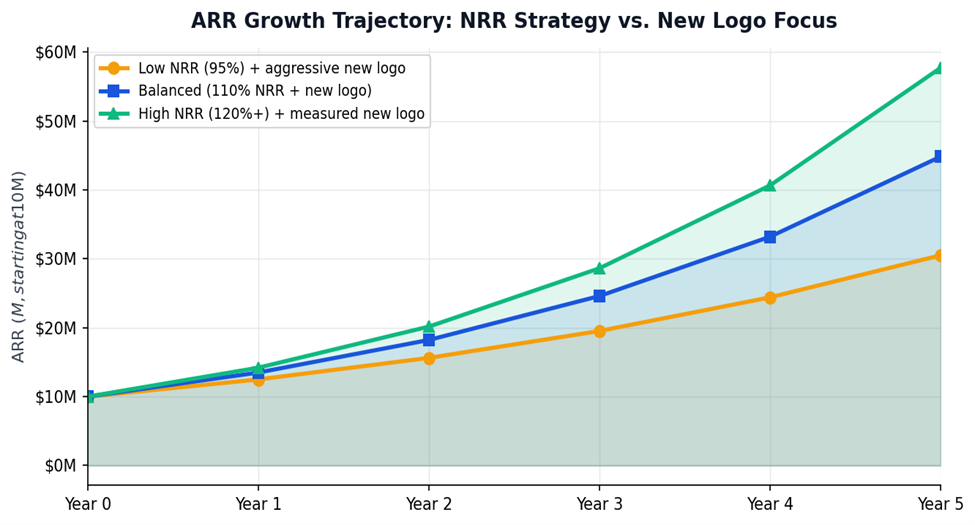
ARR growth trajectory over 5 years: three NRR strategies starting from $10M ARR. High NRR compounds to 2.7× the outcome of a low-NRR new logo-focused strategy. Source: Business Infomatics modelling.
7× lower customer acquisition cost for expansion revenue vs. cold new logo outbound. The economics of retention-led growth are not close. (OpenView SaaS Benchmarks, 2025)
What Net Revenue Retention Actually Measures — and Why It Matters More Than Growth Rate
Net Revenue Retention is the percentage of ARR retained from a cohort of customers over a twelve-month period, including expansion from that cohort, net of churn and downgrades. An NRR of 100 percent means the existing customer base is stable — every dollar of churn is being offset by expansion within the same cohort. An NRR above 100 percent means the existing customer base is growing without any new logo contribution. An NRR of 120 percent means that even with zero new customer acquisition, the company would grow 20 percent per year from expansion within its existing base.
The compounding effect of NRR becomes visible over multi-year periods in a way that is genuinely non-obvious until you model it out. Two companies starting at ten million dollars ARR with identical new logo growth rates but different NRR — one at 95 percent and one at 120 percent — arrive at very different revenue positions by year five. The high-NRR company does not just grow faster; it grows cheaper, because expansion revenue requires a fraction of the sales and marketing investment that new logo revenue requires, which means it flows to the bottom line at a meaningfully higher margin.
This arithmetic is known. What is less well understood is how operationally difficult it is to actually achieve NRR above 110 percent consistently, and how specific the conditions are that make it possible. High NRR is not a consequence of having a good product — it is a consequence of having a customer success function that is structured, resourced, and incentivised to produce expansion outcomes, working on a product that has genuine expansion surface in its architecture. Companies with a product designed for single-seat adoption and a customer success team measured on ticket resolution time will not produce high NRR regardless of product quality. The operating model and the product architecture have to be co-designed for expansion.
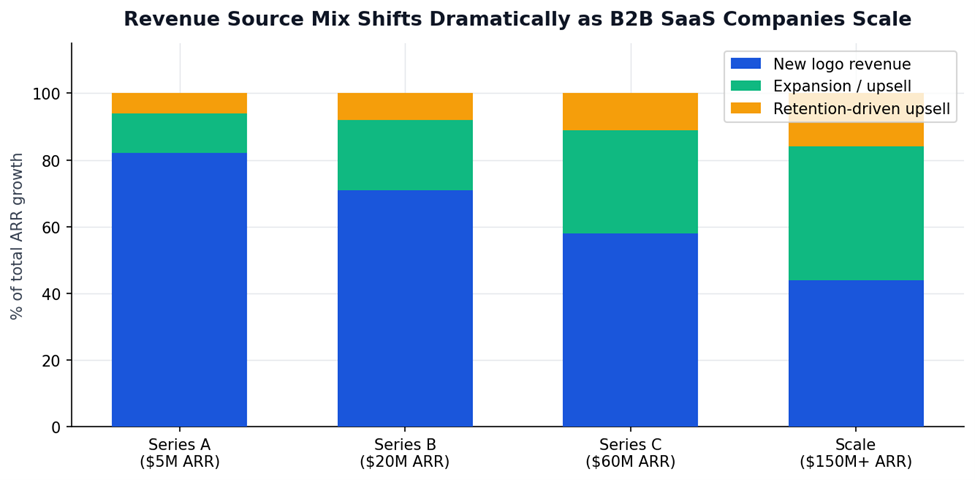
Revenue source mix shifts dramatically as B2B SaaS companies scale. At $150M+ ARR, 56% of growth comes from expansion and retention motions — not new logo. Source: OpenView SaaS Benchmarks, 2025.
Why Most CS Functions Are Structurally Mispositioned
Measuring the Wrong Things
Customer success teams in most organisations are measured primarily on retention metrics — churn rate, renewal rate, customer health scores — that capture the absence of failure rather than the presence of value creation. Retention metrics are necessary but insufficient. They tell you whether customers are staying; they do not tell you whether they are growing, whether the relationship has the depth and trust that makes expansion a natural conversation, or whether the CS team is actively generating the reference relationships and advocacy that feed new logo pipeline.
The shift from measuring retention to measuring growth requires adding expansion bookings, upsell and cross-sell conversion rates, and advocacy output — customer references generated, case studies produced, referrals made — to the CS team's performance framework. This change in measurement is also a change in what the CS team is hired for, trained to do, and rewarded for. Teams hired as retention specialists and then asked to own expansion outcomes without the corresponding skills, tools, and incentives will not produce the shift.
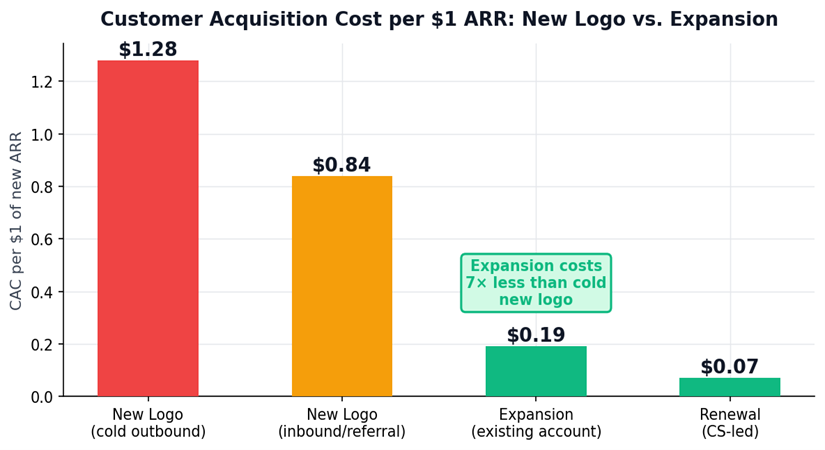
CAC per $1 of new ARR: expansion costs $0.19 vs. $1.28 for cold outbound new logo. The economics make the CS investment case without additional argument. Source: OpenView, 2025.
The Handoff Model Creates Relationship Debt
The dominant operating model in B2B SaaS separates the sales function — which owns the relationship through close — from the customer success function, which inherits it at onboarding. This handoff model creates a structural problem: the customer relationship that the sales team built was built in the context of the sales process, with the dynamics that creates — information asymmetry, performance pressure, the natural tendency to present things optimistically. The CS team inherits a customer whose expectations were set by that process, often without full access to what was promised, and is responsible for delivering the outcomes that will determine whether the customer expands or churns.
The organisations that have produced the highest NRR have typically moved away from clean handoff models toward continuous relationship architecture — where the account executive maintains a meaningful relationship with the account post-close, where CS and AE are jointly incentivised on expansion outcomes, and where the customer's path from initial purchase to multi-year expanded partnership is managed as a coherent journey rather than a series of team transfers. This is more complex to manage and requires clearer role definition to prevent the territorial dynamics that arise when multiple people are nominally responsible for the same account. The operational complexity is the reason most organisations default to the simpler handoff model. The NRR data suggests the complexity is worth managing.
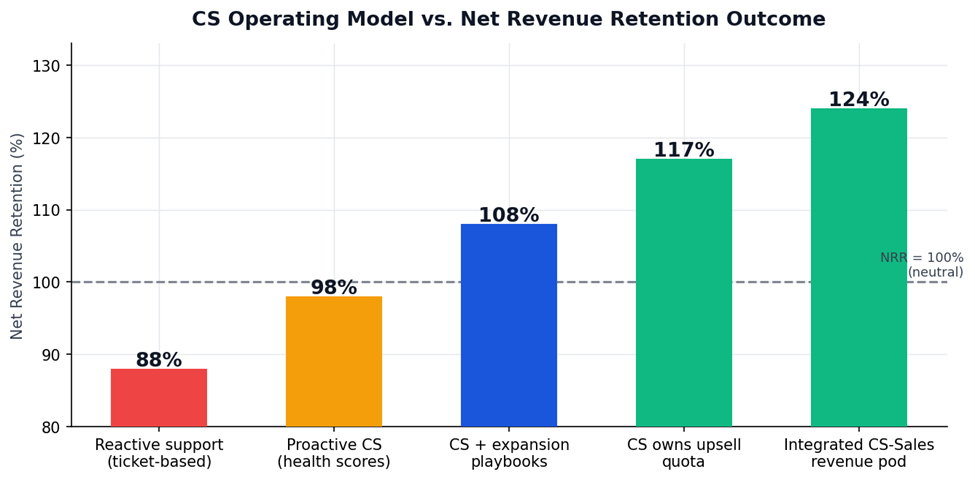
CS operating model vs. NRR outcome. Integrated CS-sales revenue pods produce NRR 36 points higher than reactive support models. Source: Business Infomatics analysis of benchmarking data.
Expansion Needs a Playbook, Not a Conversation
Expansion revenue does not happen because a CS team has good relationships with their accounts. It happens because the CS team has a structured playbook that identifies expansion opportunities at the right moments in the customer lifecycle, equips them to make the business case for expanded investment, and provides a clear handoff process when the expansion requires commercial negotiation beyond the CS team's scope. Without that playbook, expansion depends on individual CS manager initiative and the customer's own recognition of the need to expand — both of which are unreliable at scale.
The playbook elements that produce consistent expansion outcomes are well-established: an expansion trigger framework that identifies the lifecycle moments — product usage milestones, team growth signals, business outcomes achieved — that create natural expansion conversations; a business case template calibrated to the specific expansion motion (seat growth, product tier upgrade, adjacent product); and a defined process for routing expansion-ready accounts to an AE for commercial discussion while preserving the trust relationship the CS team has built. Building this infrastructure is a project, not a conversation. The organisations that have done it are generating meaningfully more expansion revenue per CS headcount than those relying on relationship quality alone.
What to Change First
For organisations where CS is currently operating as a support and retention function and the leadership team has recognised that the expansion opportunity is being left on the table, the sequencing of change matters. Trying to redesign the entire operating model simultaneously — changing measurement, restructuring teams, redefining roles, rebuilding the product expansion architecture — produces the organisational resistance that comes from too much change at once and typically results in partial implementation that captures neither the simplicity of the old model nor the growth potential of the new one.
The highest-leverage starting point is usually measurement. Adding expansion bookings as a CS team metric — initially alongside existing retention metrics, not in replacement of them — changes what the team's weekly reviews are about and creates permission for CS managers to invest time in expansion conversations that the current measurement framework treats as outside their scope. The measurement change also surfaces the data needed to understand where expansion is and is not happening, which informs the playbook development and the role design decisions that come next.
The companies that have made this transition most cleanly are the ones that had a CS leader who understood the revenue argument and had the credibility with the CFO and CRO to make it compellingly — not as a request for more investment in a support function, but as a specific, data-backed proposal to redirect the organisation's growth investment toward the highest-return motion available to it. That argument is becoming easier to make as the new logo market tightens and the alternative — spending more to acquire customers at increasing cost while existing customers expand at a fraction of that cost without the right operating model to capture it — becomes harder to defend.