


The average B2B enterprise deal now involves 11 stakeholders. Most sales processes were designed for three. The resulting mismatch is not a training problem — it is a structural one that requires a different selling motion entirely.
Digital Business · Sales · Business Infomatics Research Desk
There is a version of enterprise sales that most sales leaders were trained to execute: find the right executive, build a relationship, understand their problem, propose a solution, get a decision. The assumption embedded in this model is that purchase decisions are made by individuals with sufficient authority to say yes. That model describes how enterprise software was sold in the early 2000s. It does not describe how enterprise software is bought today.
Gartner's 2025 B2B buying research documents the current reality: the average enterprise technology purchase involves 11 to 14 stakeholders across multiple functions. Each of those stakeholders is independently conducting research before any of them engage a vendor directly. And the likelihood that all 14 will align on a single vendor, at the same time, with sufficient conviction to approve a purchase, is low enough that it requires deliberate management.
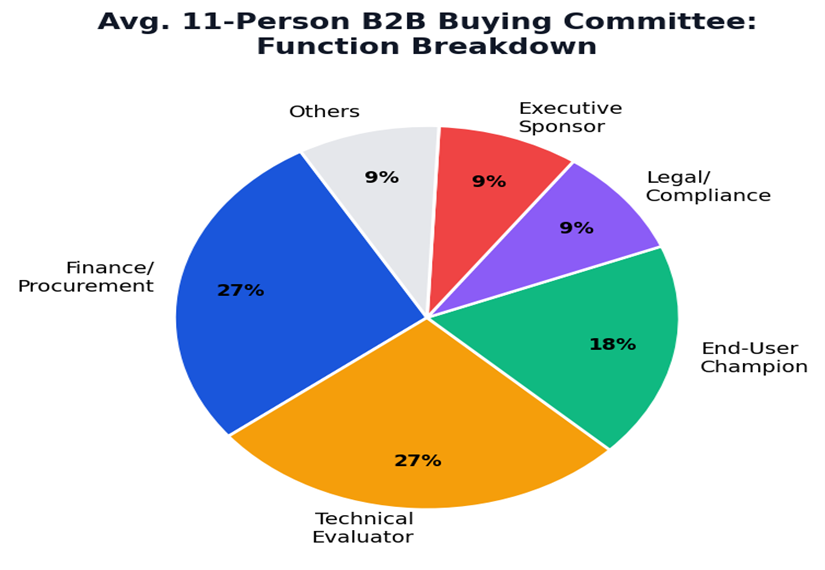
Average 11-person B2B buying committee by function. Finance, technical evaluators, and end-user champions account for the majority. Source: Gartner, 2025.
77% of B2B buyers say their purchase process is 'very complex or difficult.' The complexity is structural, not a communication failure. (Gartner, 2025)
What Multi-Threaded Selling Actually Means
Multi-threaded selling is the practice of building relationships with multiple stakeholders in an account simultaneously — across different functions, levels, and buying roles — rather than concentrating engagement on a single champion. Outreach's 2025 sales execution benchmarking found that deals with three or more active contacts are 2.3 times more likely to close than single-threaded deals. Deals with five or more active contacts close at rates 3.7 times higher.
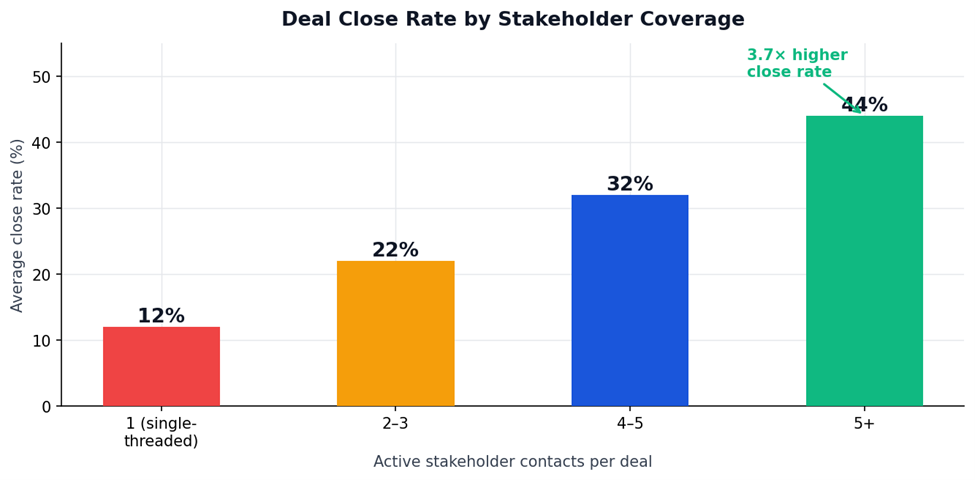
Deal close rate by active stakeholder contacts. 5+ contacts produce 3.7× higher close rates than single-threaded deals. Source: Outreach Sales Execution Report 2025.
3.7× higher close rates for deals with 5+ active stakeholder contacts versus single-threaded deals. (Outreach, 2025)
The mechanism is not complicated. A single champion, however enthusiastic, is unable to independently navigate internal consensus-building across a committee of 11 stakeholders who have different priorities and different relationships with the status quo. Multi-threaded deals have redundancy built in — and are better informed about the actual decision criteria across the committee.
Why Most Sales Organisations Are Structurally Single-Threaded
CRM Data Rewards Contact, Not Coverage
Most CRM implementations track activities against accounts and associate them with a primary contact. Reporting that shows a rep is active in an account does not distinguish between concentrated engagement with one stakeholder and distributed engagement with six. The organisations that have addressed this are tracking stakeholder coverage as an explicit deal quality metric — with minimum coverage thresholds that must be met before a deal can advance stage.
Champion-Building Training Creates Champion Dependency
The sales training methodology that dominated the 2000s and 2010s — value selling, Challenger, SPIN — was designed for smaller buying committees and more concentrated decision authority. It taught reps to find the person with the power and the problem. It did not teach how to navigate consensus-building across a distributed committee. Reps who execute this training well build excellent champion relationships — and then discover their champion cannot get the deal approved alone.
Prospecting Motions Target Titles, Not Committees
Outbound prospecting sequences in most sales organisations are built around reaching a single target persona. Multi-threaded prospecting requires simultaneously targeting multiple personas in the same account — the economic buyer, the technical evaluator, the end user — in a coordinated way that creates a coherent entry narrative. This performs significantly better on the metrics that matter.
The B2B Buying Journey Starts Long Before You Arrive
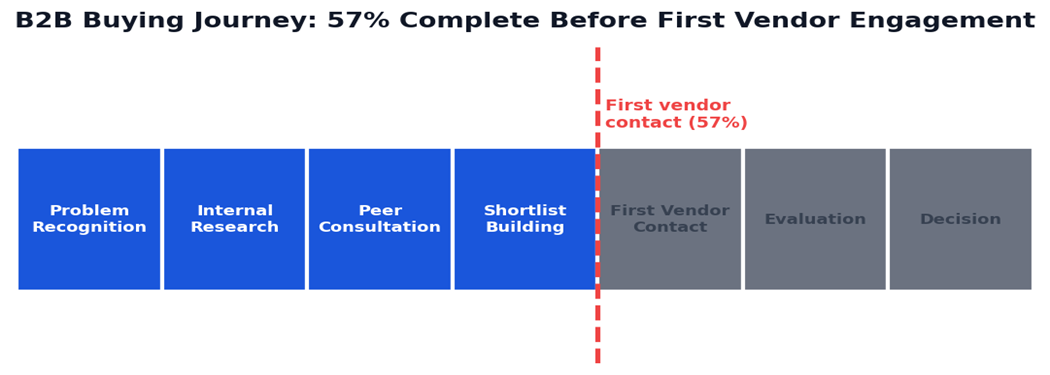
57% of the B2B buying journey is complete before first vendor contact. The champion is selling for you before you have any visibility into the process. Source: CEB/Gartner, updated 2024.
57% of the B2B purchase decision is complete before a buyer engages directly with a sales rep. The champion is selling for you before you arrive. (CEB, 2024)
Building the Multi-Threaded Muscle
Account Intelligence Before Engagement
Effective multi-threaded engagement requires knowing who the relevant stakeholders are and what their individual priorities are likely to be before the first outreach. Intent data platforms — which identify accounts showing active research behaviour across multiple individuals — provide qualitatively different intelligence: not just that an account is on your target list, but that a buying process is active and which functions are involved.
Equip Champions to Sell Internally
The most valuable stakeholder engagement a sales organisation can make is one that equips its champion to navigate internal consensus-building effectively. This means providing materials calibrated to the specific concerns of stakeholders the champion needs to persuade — a CFO-focused business case, a CISO-friendly security summary, a reference story from a comparable organisation. The organisations whose sales teams execute this well treat internal champion enablement as a distinct sales competency.
Deal Reviews That Expose Coverage Gaps
Pipeline reviews that focus primarily on stage, amount, and close date are optimised for forecast accuracy at the expense of deal quality diagnosis. Restructuring reviews to assess stakeholder coverage — who is engaged, at what depth, which roles are uncontacted — surfaces the coverage gaps that predict late-stage losses before they happen. This requires stakeholder maps in the CRM and the tool support to make them easy to populate and review.
The Honest Assessment
Multi-threaded selling is not difficult to understand. It is difficult to execute consistently at scale because it requires changes to prospecting motion, CRM configuration, training curricula, pipeline review process, and content infrastructure simultaneously. The organisations that have made this shift started with deal quality metrics, used those metrics to expose the cost of single-threaded engagement in real pipeline, and used that evidence to build the case for the process and infrastructure changes required. Start with the measurement. The behaviour change follows.