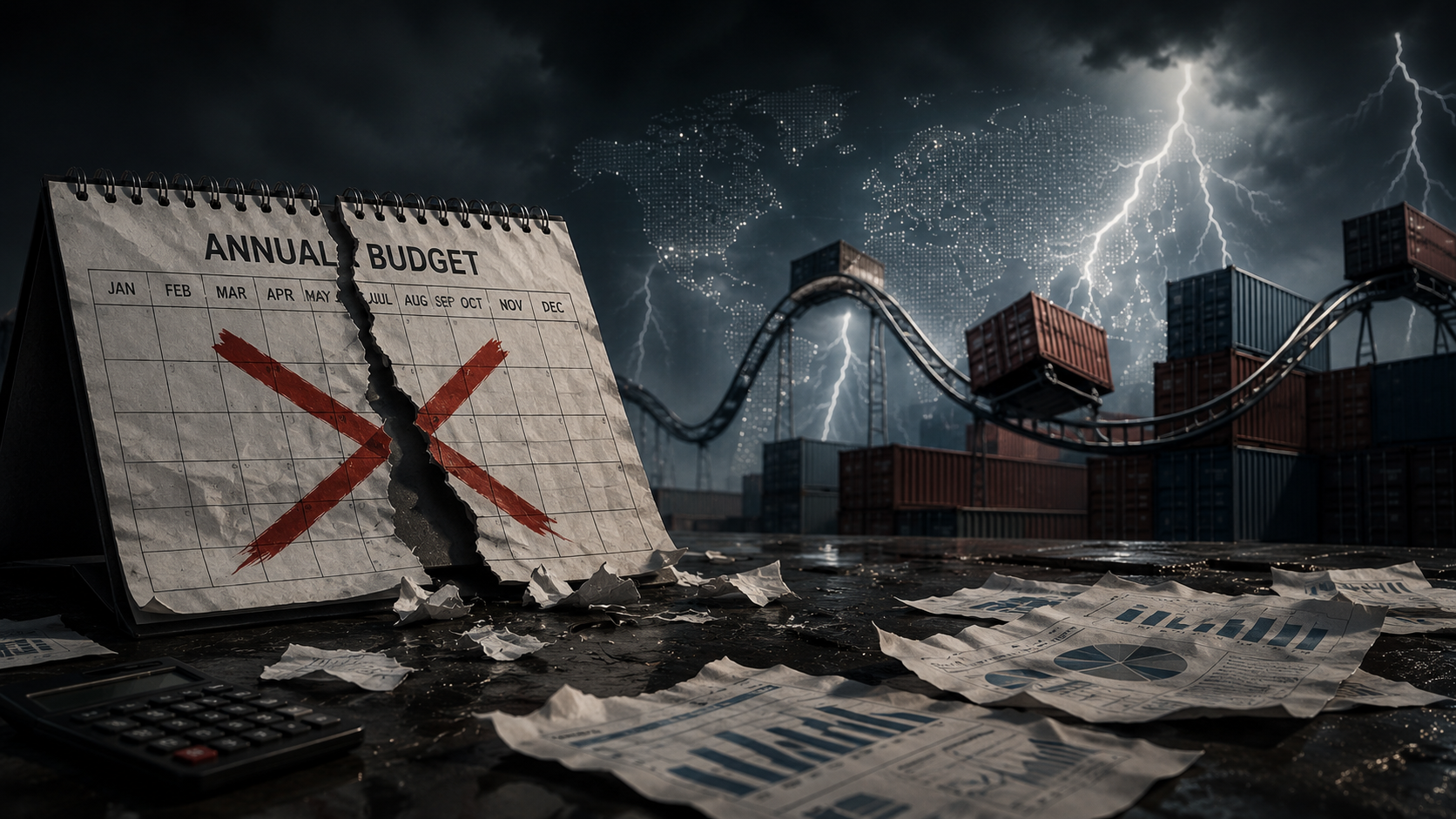
When the cost of your inputs can change by policy announcement, a number you set last December isn't a plan. It's a guess you've stopped updating.
The annual budget is one of the most durable rituals in business. Every autumn, finance builds a plan for the year ahead, the board approves it, and for the next twelve months the organization measures itself against a set of numbers fixed before anyone knew what the year held. The ritual survives because it usually worked well enough — the world didn't move fast enough between December and the following December to make the numbers absurd.
That tolerance has run out. Tariff rates are now at levels not seen in roughly eighty years, and — this is the part that breaks the old model — they move on policy timelines, not economic ones. A cost base can shift materially on an announcement, in a direction and magnitude nobody could have priced into an annual plan. Analysts estimate price growth would have run meaningfully lower in 2026 without tariff effects. When your input costs can be repriced by something outside your industry and outside your forecast, a budget set once a year isn't a plan. It's a stale guess the whole company is still being measured against.
Why this volatility is structural, not a passing storm
The instinct of any seasoned CFO is to wait it out — disruptions pass, and the annual cycle has survived plenty of them. The reason this is different is that the source of the volatility is policy, and policy doesn't mean-revert on a schedule you can plan around. Trade realignment has already changed how companies approach sourcing, pricing, logistics, and network design. This isn't a single shock to absorb and move past; it's a higher baseline of uncertainty that persists because its cause is structural.
CFOs have noticed. Surveys put scenario planning and forecasting at the top of the 2026 finance agenda, and leading teams are shifting from treating tariffs as a one-time line item to running continuous models of how cost, pricing, and margin move as conditions change. The annual budget didn't fail because finance got worse at its job. It failed because the assumption underneath it — that the planning horizon is stable — stopped being true.
A budget assumes the ground holds still for a year. Tariff policy made the ground a moving thing. You can't plan on a moving surface with a number you refuse to update.
From annual budget to continuous planning
The replacement isn't "budget more often." It's a different operating model. Continuous planning treats the financial plan as a living model that updates as inputs change, rather than a document approved once and defended for twelve months. Instead of one set of numbers, finance maintains a small set of scenarios — base, tariff-up, tariff-down — and pre-decides what the business does at each, so that when conditions move, the response is a switch already built, not a fire drill.
The enabling shift is where the team spends its time. In the old model, FP&A burned most of its capacity collecting and reconciling data, leaving little for analysis. Continuous planning only works when that collection is automated, freeing the team to do the part that actually matters under volatility: modeling alternatives and pre-wiring the decisions. This is also where AI earns its place in finance — not as a forecasting oracle, but as the engine that makes running many scenarios continuously cheap enough to be practical.
Visual 1 — Two operating models
Dimension | Annual budget | Continuous planning |
|---|---|---|
Cadence | Set once, defended for 12 months | Updated as inputs move |
Output | One fixed set of numbers | A few live scenarios with triggers |
Response to a shock | Re-forecast scramble, weeks late | Pre-decided switch, executed in days |
FP&A time spent on | Collecting and reconciling data | Modeling alternatives and decisions |
Cross-functional link | Finance plans, others react | Finance, procurement, and trade plan together |
How to read it: the right column isn't a faster version of the left — it's a different posture. The payoff is in the third row: response time to a cost shock measured in days rather than weeks.
The contrarian caution: don't drown in scenarios
There's a failure mode hiding inside this advice. Told to plan for volatility, an anxious finance team can generate endless scenarios and end up paralyzed — modeling every permutation, deciding nothing, mistaking activity for readiness. Continuous planning is not "more spreadsheets." Its entire value is that it ends in pre-made decisions: if tariffs on this input rise past a threshold, we re-source here, reprice there, and protect this margin. A scenario with no decision attached is just anxiety with a chart. The discipline is to keep the scenario set small and the triggers explicit — three live cases the organization can actually act on, not thirty it can only admire.
What this means for leaders
Stop treating the budget as a contract. Reframe it as a baseline that's expected to move, and change how performance is judged accordingly — against current conditions, not a number frozen before the conditions were known. Holding teams to a stale plan in a volatile year punishes them for reality.
Pre-decide, don't just pre-model. The deliverable of scenario planning isn't the scenarios; it's the trigger-and-response set attached to them. When a tariff lands, the question "what do we do?" should already be answered. That's the difference between agility and panic.
Plan across functions, or don't bother. Tariff volatility hits sourcing, pricing, logistics, and finance at once, and a finance-only model misses most of the levers. The organizations adapting fastest connect finance, procurement, and trade in one planning loop — because the response to a cost shock is rarely financial alone.
The annual budget had a good run. It earned its place in a world that changed slowly enough to plan a year at a time. That world isn't coming back on the timeline of trade policy, and the finance teams that keep defending last December's numbers will spend the year explaining variances instead of managing them. The ones that move to continuous planning won't be surprised by the next announcement. They'll already have decided what to do about it.
A BusinessInfomatics original. Drawn from 2026 CFO surveys and commentary on tariff planning (Deloitte, RSM, Workday, CFO Brew, The CFO) and analysis of trade-policy volatility and continuous-planning models.