
Only 49 percent of B2B sales reps hit their quota in a typical enterprise organisation. The standard response is a coaching problem, a hiring problem, or a market problem. It is rarely acknowledged as a compensation design problem. It usually is.
Sales · Business Infomatics Research Desk
Sales compensation is the most powerful behavioural lever available to a revenue organisation. The structure of quotas, commission rates, accelerators, and kickers determines — with a precision that should make anyone designing these plans thoughtful — exactly what activities salespeople prioritise, how they manage deal timing, what kind of customer they pursue, and how they treat the accounts they have already won. Get it right and you have an organisation that systematically does the things that produce durable revenue growth. Get it wrong and you have an organisation that is highly optimised for behaviour that looks good in certain metrics and quietly destroys value in others.
Most sales compensation plans are not right. They have evolved incrementally from plans that were designed for a different company at a different growth stage, absorbing revisions each year that addressed specific problems without confronting the structural logic of the plan as a whole. The result is typically a plan that creates genuine perverse incentives — rewards that produce the opposite of the behaviour the organisation needs — alongside a set of structural features that make the problems invisible until they show up in churn rates, pipeline volatility, and the quarterly forecast misses that are blamed on everything except the compensation system that caused them.
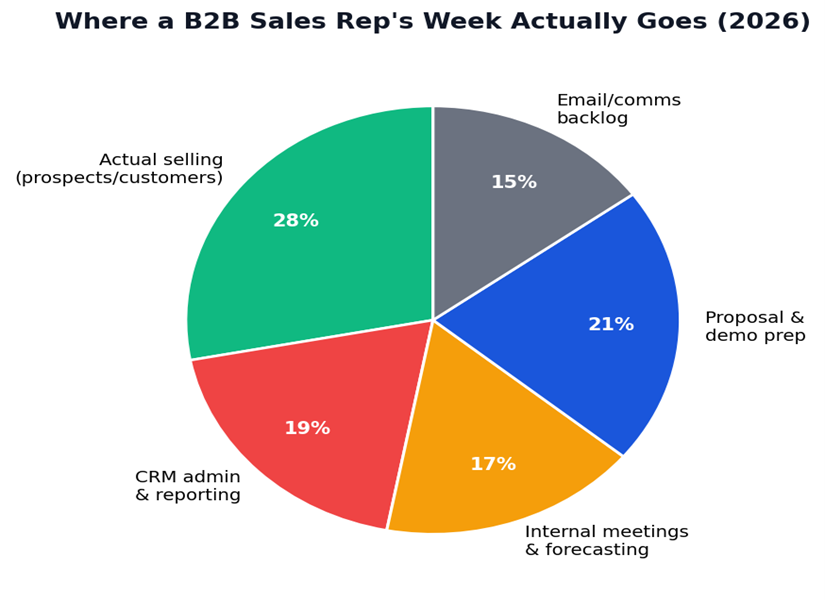
Where a B2B sales rep's week actually goes. Only 28% of time is spent actively selling — the rest is admin, meetings, and prep. Source: Salesforce State of Sales, 2025.
49% of B2B enterprise sales reps hit their annual quota. The majority miss — yet most comp plans were not redesigned in response. (Salesforce State of Sales, 2025)
The Structural Problems That Most Plans Share
The Annual Reset Creates a Predictable Distortion Every Year
Annual quota reset is the default model in most enterprise sales organisations. Quotas are set in January based on the prior year's performance and the coming year's targets, commission rates run against those quotas for twelve months, and the cycle resets on December 31. This structure creates two predictable distortions that most sales leaders can describe from experience but rarely connect directly to the compensation design.
The first is Q4 sandbagging. Reps who have already hit or exceeded their annual quota have a strong incentive to hold deals that are closable in December into January — where they will count against a fresh quota at the full commission rate rather than being locked into the current year's accelerator structure. Deals that could close in Q4 slip to Q1 not because the customer isn't ready but because the rep's incentive structure makes January a better month to book them. The magnitude of this effect shows up in Q1 pipeline quality analysis that consistently shows first-quarter deals have shorter average sales cycles than Q2 through Q4 equivalents — because a meaningful portion of them were closable in the previous quarter.
The second distortion is the January drought in pipeline activity. Reps who are starting the year with a fresh quota and fresh commission structure have an incentive to invest January in prospecting and opportunity development that will pay out in Q2 and Q3, not to accelerate deals into a month where commission is at the base rate. The result is an annual pattern of pipeline volatility — Q4 artificially deflated by sandbagging, Q1 artificially inflated by the previous year's held deals, with a genuine trough in new pipeline activity that shows up in the Q2 funnel — that is entirely a function of the compensation structure and could be partially addressed by quarterly quota resets or multi-year commission structures.
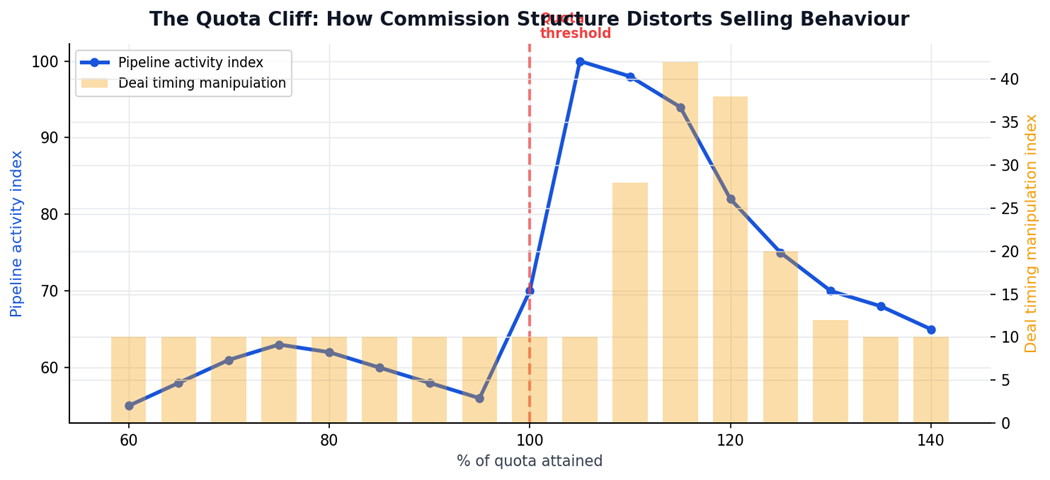
The quota cliff: pipeline activity and deal timing manipulation indexed against quota attainment. Sandbagging spikes sharply just above quota — a direct artefact of commission structure. Source: Business Infomatics analysis.
Accelerators Reward the Right Outcome With the Wrong Mechanism
Accelerated commission rates above 100 percent of quota — paying, say, 150 percent of the standard rate on revenue booked above quota — are designed to reward overperformance and incentivise the highest-performing reps to keep selling hard when they could coast. The intention is correct. The implementation often creates a secondary problem: reps who are tracking to exceed their quota have an incentive to maximise the deals they close in the accelerator band, which means timing deals to arrive in the period when they count toward it. This can mean pulling deals forward when they are not fully qualified — promising aggressive timelines, discounting to close, papering over customer concerns — to book them before a period ends. The commission structure rewards booking the deal. The customer success team inherits whatever was promised to book it.
New Logo and Expansion at the Same Rate Is a Growth Allocation Error
The majority of enterprise sales compensation plans pay the same commission rate on new logo ARR and on expansion ARR from existing accounts. This decision is typically made on simplicity grounds — one rate is easier to administer, explain, and calculate than a differentiated structure. The simplicity is real. The cost is also real: a uniform rate structure sends no signal to reps about which type of revenue the organisation values more at a given growth stage, and in practice, the path of least resistance — following up with existing accounts who already know the company and need less discovery — will consistently win against the harder work of new logo acquisition unless new logo is explicitly weighted to compensate for the difficulty premium.
Conversely, at the growth stage where expansion is genuinely the higher-value activity — where NRR is the primary driver of compounding growth — paying the same rate on new logos as on expansion work may reward the wrong allocation of selling time. The organisations that have gotten the most out of their compensation redesign efforts have typically done the work of modelling what mix of new logo, expansion, and renewal revenue they actually need at their current growth stage, and designing the rate structure to make the optimal allocation the path of least resistance for the rep.
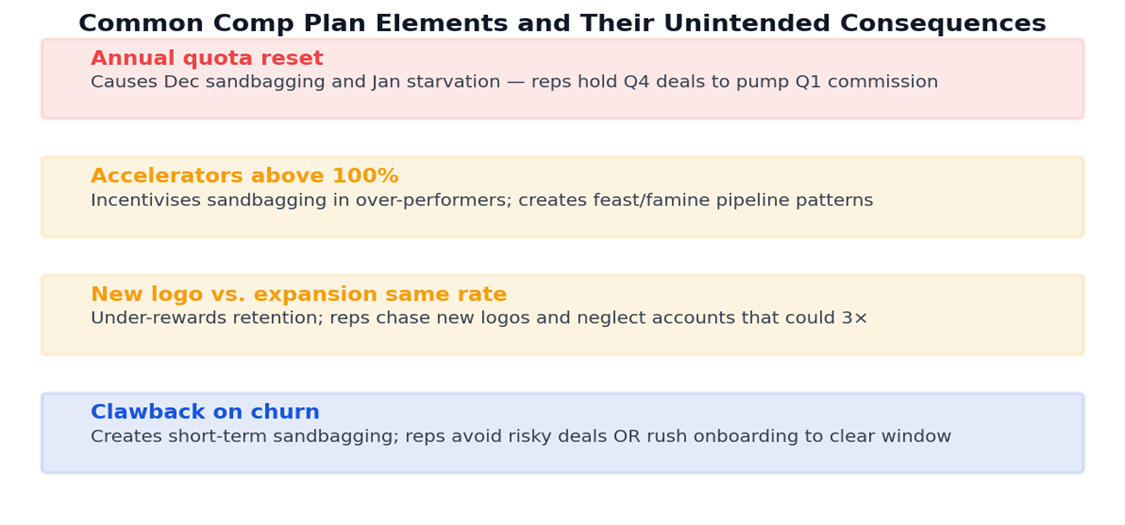
Common comp plan elements and their unintended behavioural consequences. Each feature solves one problem while creating another — the system needs to be redesigned as a whole. Source: Business Infomatics framework.
What Effective Compensation Design Actually Requires
Model the Behaviour Before You Set the Rates
Effective comp plan design starts with a specific question: given the structure we are proposing, what is the rational self-interested behaviour of a rep who is trying to maximise their personal earnings? If the honest answer to that question includes sandbagging, cherry-picking, deal manipulation, or neglecting retention, the plan has a design problem that adding a new kicker or adjusting a single rate will not fix. The modelling exercise is not complicated — it requires sketching out the scenarios a rep faces at different attainment levels, identifying where the incentive structure points toward organisationally valuable behaviour and where it doesn't, and redesigning the mechanism that creates the misalignment.
Quota-Setting Is Where Most Plans Actually Break
The most common proximate cause of low quota attainment is not compensation structure — it is quota-setting that is not grounded in what is actually achievable given the territory, the product-market fit, the sales cycle length, and the rep's ramp stage. Quotas that are set top-down from a revenue target without modelling bottom-up capacity produce the distribution in the attainment chart: a minority of reps in the accelerator band, a majority missing, and an average attainment that falls well short of what the compensation cost was designed to produce.
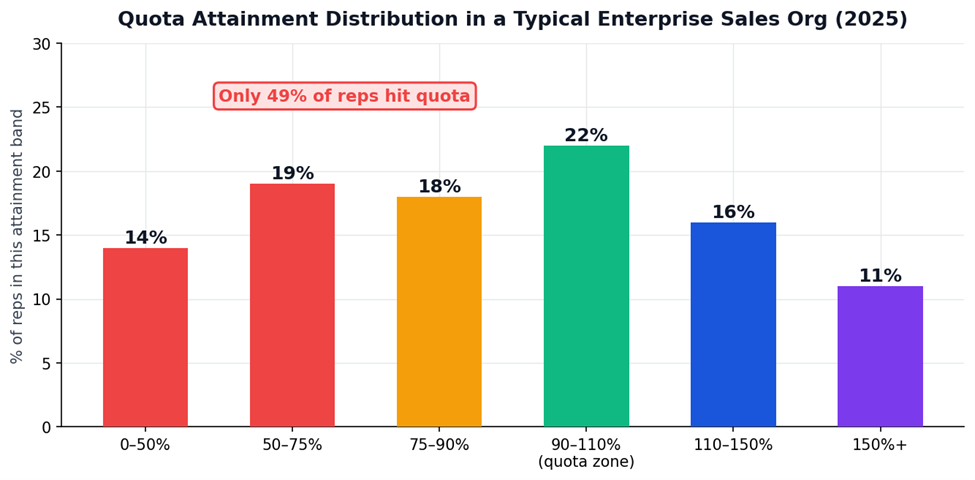
Quota attainment distribution in a typical enterprise sales org. 33% of reps are significantly below quota — rarely a performance problem, usually a quota-setting problem. Source: Salesforce, 2025.
The organisations with the most consistent quota attainment use a combination of historical attainment analysis by territory and segment, market capacity modelling that estimates the genuine addressable revenue per territory, and a deliberately designed attainment distribution target — for example, aiming for 65 to 70 percent of reps hitting quota in a healthy plan rather than accepting sub-50 percent as normal. Designing for an attainment distribution requires willingness to set quotas at levels that are genuinely achievable, which creates tension with top-down revenue planning. Resolving that tension honestly — by aligning revenue targets to realistic capacity rather than forcing quota onto a capacity that cannot support it — is the core discipline of effective comp plan management that the majority of sales organisations have not built.
Transparency Is a Retention and Performance Lever
Research on compensation transparency consistently shows that reps who understand how their compensation plan works — how their commission is calculated, how accelerators are structured, what the pathway to higher earnings looks like — perform better and stay longer than those who do not. This sounds obvious, but the typical enterprise sales compensation plan is complex enough that a meaningful share of reps cannot accurately calculate their expected commission on a deal they are about to close without help from sales operations. A plan that is too complex to be internalized cannot drive the behavioural outcomes it is designed to produce. Simplification is not just an administrative preference — it is a performance intervention.