
The EU Pay Transparency Directive is not a future compliance challenge. Enforcement begins in 2026 for large employers, with requirements that most organisations are not remotely ready to meet. The companies treating this as a disclosure exercise are going to find that the real cost is what the disclosure reveals.
People & Workplace · Business Infomatics Research Desk
Pay transparency has been gathering legislative momentum for several years, building from early US state-level requirements in Colorado and New York toward the comprehensive EU framework that is now on an enforcement timeline. The legislative direction is not ambiguous — transparency in compensation is becoming a baseline legal requirement in most major economies, and the organisations that are still treating it as an optional or distant concern are making a planning error with significant financial and reputational consequences.
The EU Pay Transparency Directive, adopted in 2023, requires member states to transpose its provisions into national law by June 2026. For large employers — organisations with 250 or more employees in the EU — the initial reporting requirements take effect from that date. Employers with 150 to 249 employees follow three years later. The requirements go significantly further than most US-style pay transparency laws, which typically mandate only salary range disclosure. The EU directive requires job evaluation schemes to assess the equal value of different roles, pay gap reporting disaggregated by gender, and — most significantly — requires employers to justify pay differences when employees request information about comparator pay.
The last requirement is where the significant legal exposure sits. An employee who believes their pay is inconsistent with a comparator in an equivalent role now has the right to request information that would allow them to assess that. If the employer cannot justify the difference on objective criteria — factors like performance, seniority, or specific competencies — they are exposed to pay equity claims that carry enforcement by national authorities with the power to impose remedies including back pay. This is not an administrative compliance requirement. It is a structural change in the employment relationship and the legal context in which compensation decisions are made.
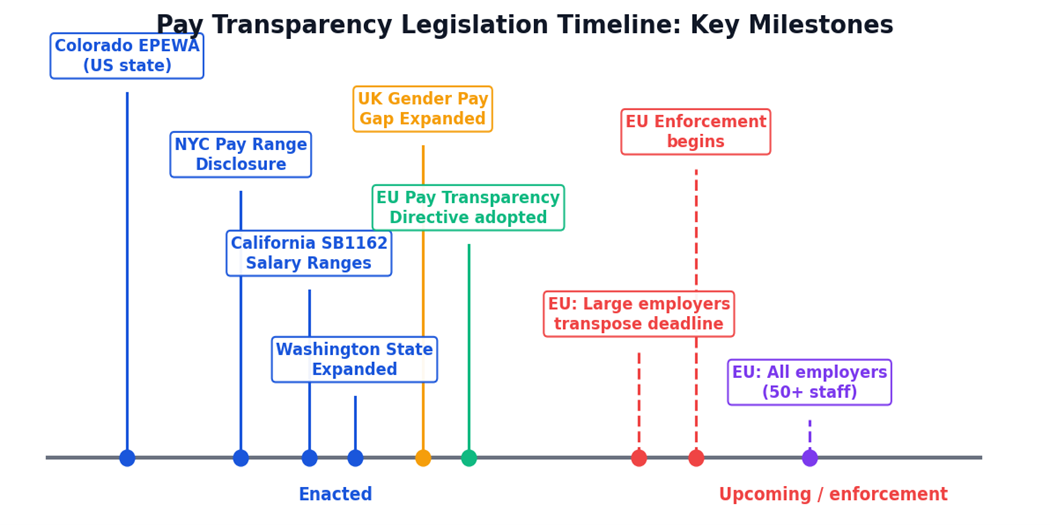
Pay transparency legislation timeline: key milestones from 2021 to 2027. EU enforcement begins 2026 for large employers, extending to all 50+ staff organisations by 2027. Source: Business Infomatics research.
Only 18% of employers in EU-member markets have a functioning job evaluation scheme meeting the directive's requirements. 82% need to build one from scratch. (Mercer EU Readiness Survey, 2025)
What the Directive Actually Requires — Precisely
Salary Range Disclosure Before Hire
Employers must provide applicants with the salary range for any advertised position before the first interview. This requirement is the most straightforward element of the directive and the one closest to what US state laws already require. The implementation challenge for employers who have not previously disclosed salary ranges is not legal — it is operational. It requires having a coherent compensation architecture in which roles are graded, grades are associated with pay bands, and those bands are maintained and can be disclosed without creating internal inequity problems.
Organisations without a functioning job architecture — those who have been setting pay by negotiation, market data, and managerial discretion rather than from a structured grade and band framework — will find that implementing salary range disclosure requires building the underlying architecture first. This is not a quick project. A comprehensive job architecture implementation for a 500-person organisation typically takes six to twelve months.
Pay Gap Reporting With Mandatory Justification
Employers must report their gender pay gap annually — not just the overall gap but gaps disaggregated by job category. The reporting framework is more granular than the UK's existing gender pay gap reporting, which requires only aggregate organisation-level figures. And crucially, when a pay gap exceeds five percent in any job category and cannot be justified by objective factors, employers must undertake a joint pay assessment — a structured analysis conducted with employee representatives that identifies the sources of the gap and produces a remediation plan.
For employers whose pay data contains unexplained gaps — which, based on Mercer's 2025 European benchmarking, describes the majority — this requirement creates a compliance obligation to remediate those gaps on a defined timeline. The five percent threshold sounds modest until you run the analysis across every job category in a complex organisation and discover how often gaps at that level or above exist in the data.
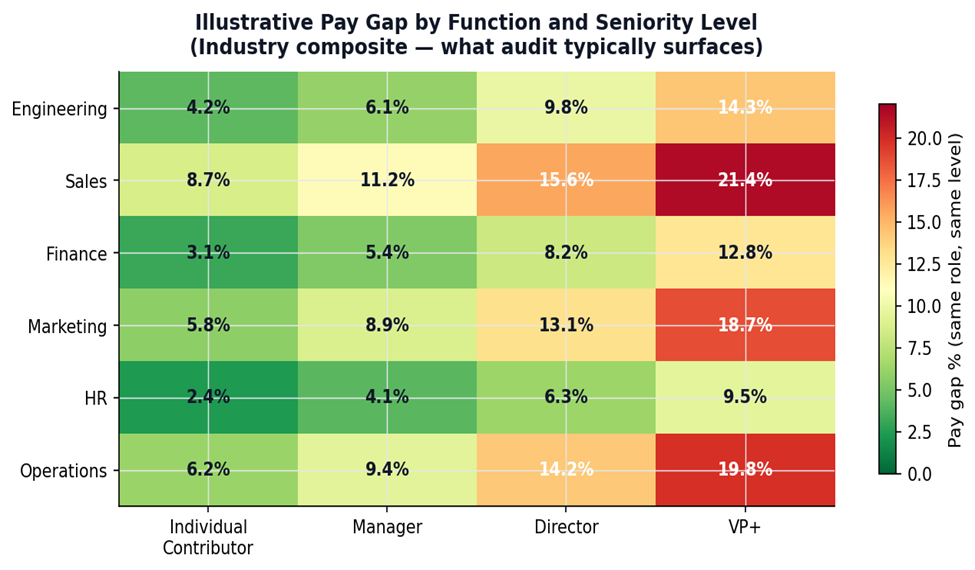
Illustrative pay gap by function and seniority level — typical industry composite. Gaps compound with seniority and are most pronounced in Sales, Operations, and Finance at VP+ level. Source: Mercer European Compensation Survey, 2025.
The Right to Individual Pay Information
The provision with the most significant operational implications is the right of employees to request information about the pay of comparators — colleagues in roles of equal value. Employers must respond to these requests within two months, providing the pay range for the relevant category and the average pay of colleagues in comparable roles, disaggregated by gender. An employee can then use this information as the basis for an equal pay claim if it reveals a gap they believe is unjustifiable.
Managing this right requires employers to have their job evaluation and compensation data in a state where they can respond accurately and consistently to requests. It also requires a process for handling requests that is legally robust — ensuring that responses are accurate, that privacy obligations are respected, and that the organisation's legal exposure from the disclosure is understood before the disclosure is made. Organisations building this capability after the first requests arrive will be doing so under pressure. Building it now is significantly more manageable.
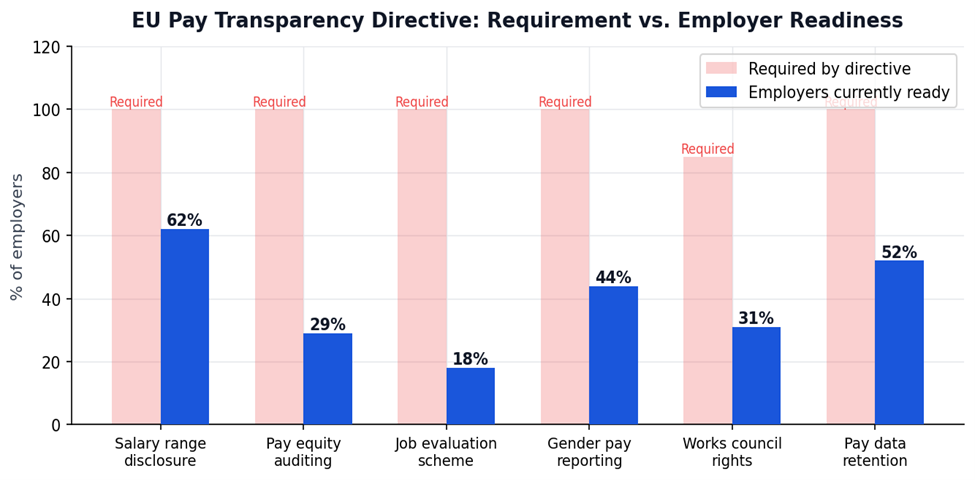
EU Pay Transparency Directive: employer readiness vs. requirements across key compliance areas. Pay equity auditing (29%) and job evaluation schemes (18%) show the largest gaps. Source: Mercer EU Readiness Survey, 2025.
The Internal Audit You Need to Do Before 2026
The single most important action for any organisation within scope of the EU directive — or any employer in a jurisdiction with significant pay transparency obligations — is to conduct a comprehensive pay equity analysis before the legal requirements create pressure to do so publicly. An internal analysis conducted without external disclosure provides the opportunity to identify and remediate gaps in a controlled process, with the benefit of legal privilege in some jurisdictions that protects the findings from discovery in subsequent litigation.
A pay equity analysis compares the compensation of employees in roles of equal value, controlling for the objective factors that legitimately explain differences — seniority, performance, location, specific skills. The residual gap after controlling for legitimate factors is the unexplained gap that creates legal exposure under pay transparency frameworks. The distribution of that gap by gender, ethnicity, age, or other protected characteristics determines the nature and scale of the remediation required.
Most organisations that run this analysis for the first time find some unexplained gaps. This is not a moral failing — it is the predictable output of compensation systems built around negotiation and managerial discretion over many years, without systematic controls for consistency. The organisations managing this well are the ones that treat the analysis findings as a business problem to be solved rather than a liability to be managed — building the job architecture, tightening the compensation governance, and addressing the salary adjustments required to reach a defensible position before they are required to disclose.
The Business Case That Goes Beyond Compliance
The compliance framing of pay transparency misses the business case that makes proactive adoption economically rational independent of legal requirements. The organisations that have moved ahead of legislation on salary transparency consistently report improvements in talent acquisition outcomes — higher offer acceptance rates, reduced time to fill, larger applicant pools — because candidates who would previously have self-selected out of a process without knowing whether the compensation was competitive can make an informed decision to engage.
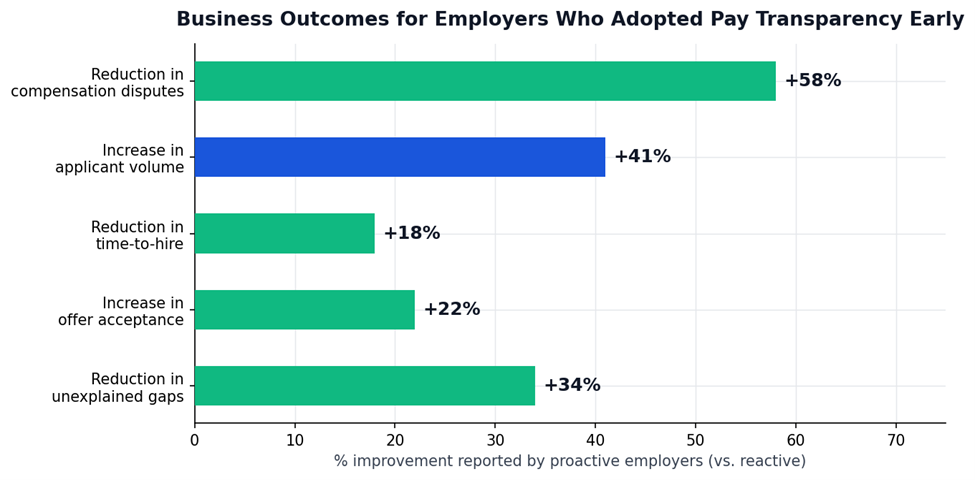
Business outcomes for employers who adopted pay transparency proactively vs. reactively. Compensation dispute reduction (58%) and applicant volume growth (41%) are the strongest effects. Source: SHRM/Radford Pay Transparency Impact Study, 2025.
41% higher applicant volume and 58% reduction in compensation disputes reported by employers who adopted pay transparency proactively vs. those who did so reactively. (SHRM, 2025)
Internal equity improvements from systematic pay audits also have measurable retention effects. Employees who discover through transparent processes that their compensation is equitable relative to peers are more likely to remain with the organisation than those who suspect inequity without the information to assess it. The uncertainty itself drives attrition — particularly among high-performing employees who have the most options. Pay transparency, done well, removes that uncertainty.
The organisations that will manage the transition to mandatory pay transparency most smoothly are those that treat it as an opportunity to build compensation systems that actually work — structured, equitable, and aligned to the outcomes the business needs from its workforce — rather than as a disclosure requirement imposed from outside. The legal deadline creates urgency. The business case exists independent of the law. The organisations acting now are making a choice that looks prescient regardless of which reason they cite for making it.
Practical Steps — In the Right Order
1. Run the Internal Pay Equity Audit First
Before any external disclosure, understand what your data actually shows. Commission a pay equity analysis using regression methodology that controls for legitimate pay factors and surfaces the unexplained residual. Do this under legal privilege where possible. The findings determine everything else.
2. Build or Refresh Your Job Architecture
Salary range disclosure requires a functioning grade and band framework. If you are managing pay by job title and market reference without a formal grade structure, that is the infrastructure gap that salary range disclosure will expose. A job architecture project requires sequencing ahead of the compliance deadline, not concurrent with it.
3. Remediate Significant Gaps Before Disclosure Is Required
Salary adjustments to close unjustified gaps are a one-time cost that reduces ongoing legal exposure significantly. Budget holders need to understand this is a compliance cost with a defined business case — the alternative is materially higher ongoing litigation risk and the employee relations consequences of disclosures that reveal gaps the organisation could not explain.
4. Train Managers on the New Conversation
Pay transparency changes the conversations managers have with their teams. Employees will ask about pay ranges, about where they sit within them, and about what would move them further. Managers who are not equipped to have these conversations consistently and accurately will create inconsistency that generates exactly the kind of inequity claims the organisation is trying to avoid. Manager training on compensation conversations is not a nice-to-have in this environment — it is a compliance control.