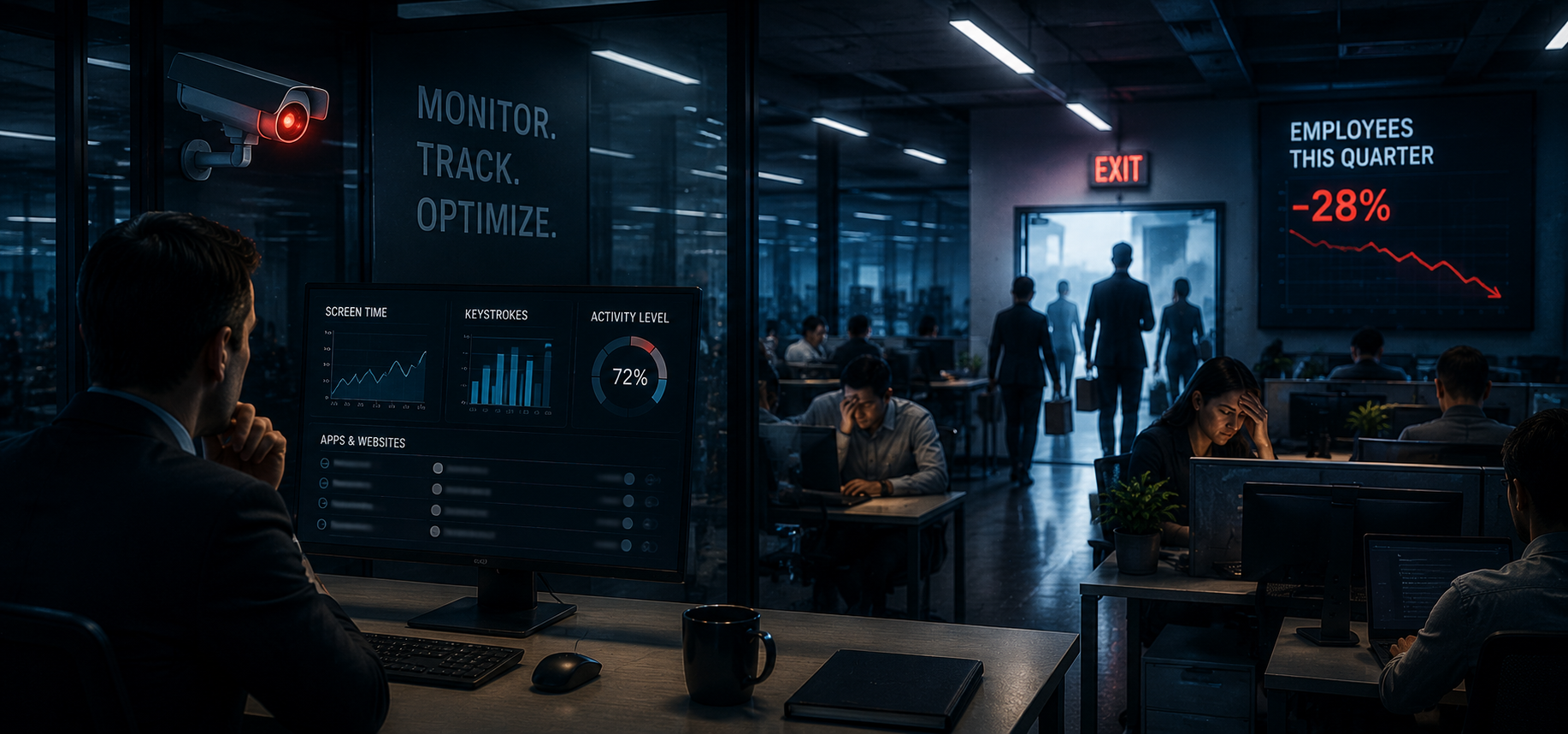
Monitoring software promised a productivity lift. The data says it delivers stress, broken trust, and a side door your best people walk out of. And the law is starting to notice.
Somewhere in your company, a license was renewed this quarter for software that watches your employees work. Keystrokes, screen time, idle minutes, maybe a webcam check. It was sold as a productivity tool, and it was approved on the quiet assumption that what gets measured gets better. Roughly 78% of companies now run some form of employee monitoring. Almost all of them believe it helps. The evidence says they're wrong, and expensively so.
Here is the case in one line. Surveillance does not lift output, it corrodes the trust that produces output, and it pushes your strongest people toward the exit while inviting a regulator to take an interest. That is a remarkable amount of damage to pay a subscription for.
The productivity case collapses on contact
Start with the only justification that matters, because it's the one written on the purchase order. Monitoring is bought to raise productivity. Yet 72% of monitored employees say it does no such thing. The mechanism people imagined, that being watched makes you work harder, turns out to be largely fictional once you account for what watching does to the watched.
What it actually produces is friction. Among monitored employees, 56% report stress or anxiety tied to the surveillance. People who are anxious about being measured optimize for looking busy rather than being effective. They keep the mouse moving. They avoid the deep, quiet work that doesn't register as activity. The tool meant to capture productivity ends up training people to perform it instead.
Surveillance is a confession, not a control. It tells your workforce you don't trust them, and people who know they aren't trusted stop giving you the effort you can't measure.
Trust is the asset you're spending
The trust numbers are where this stops being a soft concern and becomes a balance-sheet one. Some 43% of employees feel monitoring violates their trust outright; 59% say digital tracking damages workplace trust generally. Trust is not sentiment. It is the thing that makes people raise the awkward problem early, cover for a teammate, stay late on a launch nobody asked them to save. That's discretionary effort, and it is precisely the contribution no dashboard can capture and no policy can compel.
When you signal that you assume the worst, you get compliance, not commitment. The work that requires people to care, the judgment calls, the early warnings, the extra mile, dries up first, and it dries up invisibly. You won't see it leave. You'll only notice, quarters later, that things that used to get caught now don't.
The exit door you installed yourself
Then there's the retention math, which is brutally direct. Among monitored employees, 42% plan to leave within a year. Among unmonitored peers, that figure is 23%. You have nearly doubled your voluntary attrition risk, and you've concentrated it among exactly the people who have somewhere else to go: the skilled, the in-demand, the ones whose departure costs you the most to replace.
Figure 1 · What monitoring promised vs. what it measured
Claimed benefit | What the data actually shows |
|---|---|
Higher productivity | 72% of monitored staff say it doesn't improve their productivity |
Stronger oversight, healthy culture | 56% report stress or anxiety; 59% say tracking damages trust |
Better retention of talent | 42% of monitored employees plan to leave within a year, vs. 23% unmonitored |
Safer, more controlled environment | Tested platforms found sharing worker data with third parties; new laws emerging |
How to read it: Each row pairs the reason monitoring gets approved with the measured outcome. Across every dimension the tool was bought to improve, the data points the other way.
The privacy and legal bill is now coming due
The risk isn't only cultural. Several monitoring platforms, when examined, were found quietly passing worker data to third parties including Google, Facebook, and Microsoft. So the surveillance you installed to protect the business may itself be leaking the business's data out the side. That is the kind of detail that reads very badly in a disclosure.
Regulation is catching up to the practice. California's proposed "No Robot Bosses" legislation would require human review of automated disciplinary decisions and ban certain biometric and emotion-detection surveillance at work. The era of deploying this quietly and assuming no one will object is ending. The cost of having built your operation around invasive monitoring is about to include compliance, not just culture.
What this means for leaders
Audit what you already run, and be honest about why. If 78% of companies monitor, you very likely do, possibly through tools you've forgotten you bought. Find them, ask what business problem each was meant to solve, and check whether it solved it. Most won't survive the question. The ones sharing data with third parties should not survive the week.
Measure outcomes, not activity. The whole premise of bossware is that inputs predict value. They don't, and watching them taught your people to fake the inputs. Define what good output looks like for each role and manage to that. It is harder than reading a dashboard, which is exactly why it works.
Treat trust as the cheaper investment, because it is. Doubling your attrition risk among your best performers costs vastly more than the modest gains monitoring was supposed to deliver and never did. Spend the surveillance budget on managers who can lead without a camera, and you'll keep the discretionary effort the camera was driving away.
The companies still expanding their monitoring stacks think they're tightening control. They're advertising distrust, paying for the privilege, and wondering why their good people keep leaving. Control was never the thing that made teams perform. It was the thing that made them comply, briefly, on their way out.
A BusinessInfomatics original. Synthesized from 2026 workplace-surveillance research, employee-monitoring studies, and legal and HR analyses of emerging regulation.