
More than 60 percent of large employers say they have adopted skills-based hiring practices. The data on actual hiring outcomes suggests the shift is more intention than execution — and the gap matters.
People & Workplace · Business Infomatics Research Desk
The case for skills-based hiring has been made thoroughly and persuasively over the last several years. Degree requirements systematically exclude qualified candidates without improving job performance prediction. Internal talent mobility is constrained by legacy job architecture that maps roles to credentials rather than capabilities. The arguments are sound. The evidence base is solid. And the practical progress organisations have made in actually changing how they hire, develop, and deploy talent is, by most honest assessments, limited.
A 2025 Mercer survey of 800 large employers found that 64 percent described themselves as having moved to skills-based talent practices. When those same employers were asked whether they could produce an accurate inventory of skills present in their current workforce, 31 percent said they could. The gap between aspiration and operational reality is wide — and understanding why it exists is more useful than repeating the argument for why skills-based hiring is a good idea.
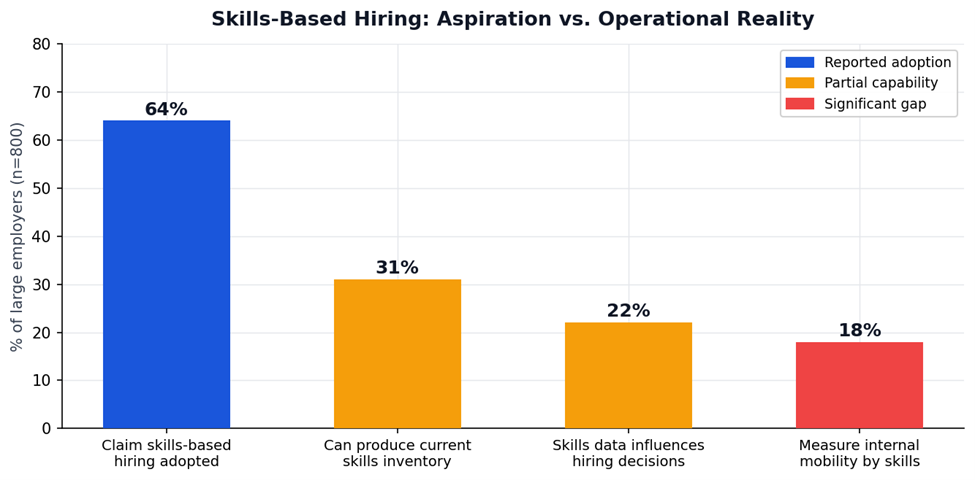
Skills-based hiring: the aspiration-to-execution gap across 800 large employers. Source: Mercer Talent Trends 2025.
What Actually Blocks Implementation
The Job Architecture Problem
Most hiring processes are built on job descriptions that were written for a credential-based world. Converting them into skills-based specifications requires identifying what a role actually needs — which methods, at what level of proficiency, applied to what kinds of problems — and building the assessment infrastructure to evaluate candidates against those criteria rather than proxy credentials. Most organisations do not have enough people with the expertise to do this at scale.
Skills Data Doesn't Exist Where You Think It Does
The skills data problem is more fundamental than it appears. Skills-based talent practices require an accurate, current, granular view of what skills employees actually have — not the skills listed on their application when they joined three years ago, but evidence-based assessment of current capability across a taxonomy that is usable for decision-making.
31% of employers who claim to practise skills-based hiring can actually produce a current skills inventory of their workforce. (Mercer, 2025)
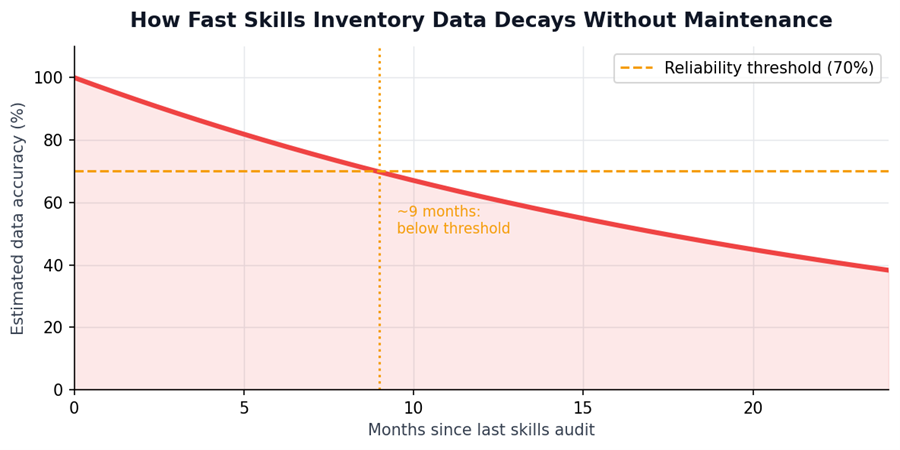
Skills inventory accuracy degrades rapidly without active maintenance. Data older than ~9 months typically falls below reliable threshold.
Assessment at Scale Is Unsolved
Even organisations that have built reasonable skills taxonomies often hit a wall at assessment. Evaluating skills rather than credentials requires methodology — structured work samples, skills tests, technical exercises, behavioural interviews mapped to specific competencies. The AI-assisted assessment market has grown substantially in response to this problem, but the reliability and bias properties of these tools vary more than their marketing materials acknowledge.
The Internal Mobility Gap Is Where the Cost Is Hiding
The productivity case for skills-based talent practices is made most clearly in internal mobility. When a business needs to staff a new initiative and searches externally, it pays a premium — agency fees, onboarding costs, the productivity ramp of a new hire learning the organisation. When the same capability exists internally, the economics are dramatically different.
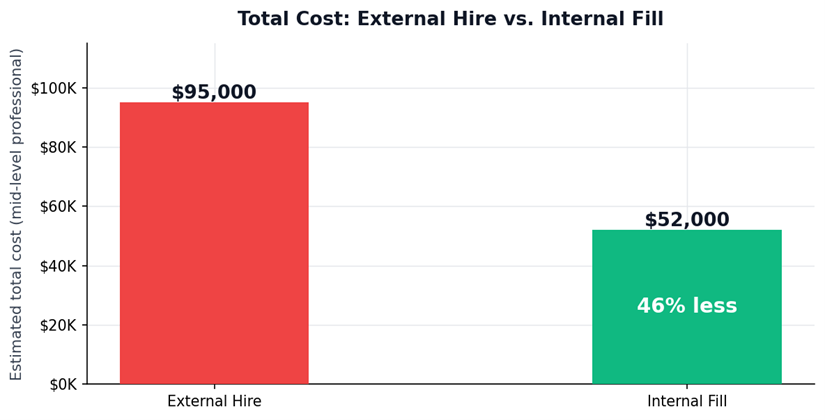
External hire vs. internal fill: total cost comparison for a mid-level professional role. Source: SHRM, 2024.
$40K–$60K estimated cost difference between external hire and internal fill for a mid-level professional role, excluding performance ramp. (SHRM, 2024)
Most organisations do not systematically identify internal candidates for open roles before going external. Not because internal candidates are not available, but because the systems and processes that would surface them — skills-mapped talent pools, internal talent marketplaces — are not in place. The organisations where skills-based practices are producing measurable business outcomes are almost always the ones where internal mobility is the primary use case.
What Good Execution Actually Looks Like
Start Narrow, Prove the Model
The organisations making real progress typically started with one function or one job family rather than attempting enterprise-wide transformation. A technology function where skills are relatively well-defined and assessment methodology is available is an easier starting point. Build a working model in a bounded context, generate data on whether skills-based selection actually predicts performance better, and use that evidence to justify the investment required for broader rollout.
The Manager Layer Is Decisive
Skills-based hiring practices implemented at the process level but not embedded in manager behaviour will not produce different outcomes. The hiring manager making the final decision is the point at which credential bias most reliably reasserts itself. Changing that requires structured decision frameworks that are actually enforced and accountability mechanisms that track whether skills-based criteria are influencing decisions.
Link Skills Data to Business Outcomes, Not HR Metrics
Skills-based talent programmes that report on skills inventory growth and assessment completion rates are measuring process compliance. The programmes that sustain executive sponsorship are the ones that can show: we filled this critical role faster, we reduced external hiring cost in this function. Those are the business outcomes that justify the investment and create the organisational will to maintain the discipline when it is inconvenient.