
Gallup's most recent global study estimates that poor management and low engagement cost the global economy $8.8 trillion in lost productivity — equivalent to nine percent of global GDP. The remarkable thing is not the scale of the number. It is that most organisations know their management is a problem, have known it for years, and have not treated it as a financial emergency.
People & Workplace · Business Infomatics Research Desk
Ask any group of working professionals whether they have ever left a job primarily because of their manager and the majority of hands in the room will go up. The lived experience of working for someone who diminishes rather than develops you — who takes credit, deflects blame, avoids difficult conversations, manages by fear or by absence, or simply lacks the judgment and communication capability to translate strategy into coherent direction — is not rare. It is routine. Research from Gallup, McKinsey, and Mercer consistently finds that between 50 and 70 percent of employees who voluntarily leave an organisation cite their direct manager as the primary or significant contributing factor.
The financial consequence of this is not abstract. It is a line item on every organisation's P&L that simply does not appear in a recognisable form because the costs are distributed across recruitment, lost productivity, onboarding, and the downstream effects on team morale and performance that no standard accounting framework was designed to capture. An organisation of one thousand employees with a fifteen percent annual voluntary turnover rate and an average replacement cost of 80 percent of annual salary is spending in the range of twelve to fifteen million dollars per year on a problem they often describe as 'unavoidable'. Much of that cost is avoidable. The part of it that flows from the quality of the manager relationship is the most avoidable part.
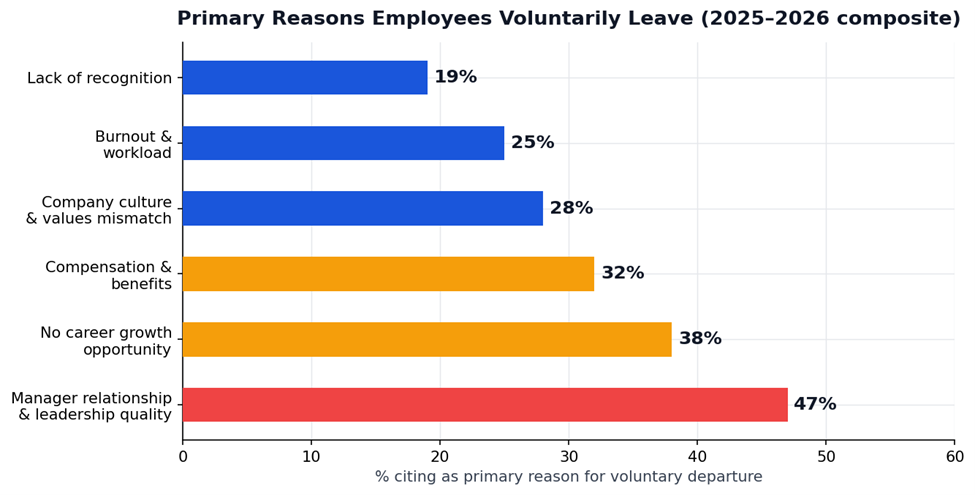
Primary reasons employees voluntarily leave, 2025–2026 composite. Manager relationship and leadership quality is cited nearly 1.5× more often than compensation. Source: Gallup, McKinsey, SHRM composite.
$8.8 trillion in annual productivity lost globally to poor management and low employee engagement — equivalent to 9% of global GDP. (Gallup State of the Global Workplace, 2025)
The Manager's Job Has Changed. The Definition Hasn't.
Part of the reason bad management is so persistent is that the definition of what good management requires has changed materially over the past decade while the ways most organisations select, develop, and evaluate managers have not. The traditional model of management — monitoring output, allocating tasks, enforcing process compliance, escalating problems — was designed for environments where work was visible, measurable, and relatively stable. It mapped reasonably well to the factory floor and the open-plan office of the 1990s, where a manager could see who was working, what they were producing, and whether they were following the established procedures.
In the environment that defines most knowledge work in 2026 — distributed teams, AI-augmented roles, work outputs that are cognitively complex and not easily monitored from a distance, employees with options and expectations that are fundamentally different from those of a generation ago — the supervisory model of management is not just insufficient. It is actively counterproductive. Employees who are capable of performing high-quality work do not improve their performance under close monitoring. They reduce it. They invest their discretionary effort in managing the manager relationship rather than in the work itself. And they leave when they find a context where their judgment is trusted.
/
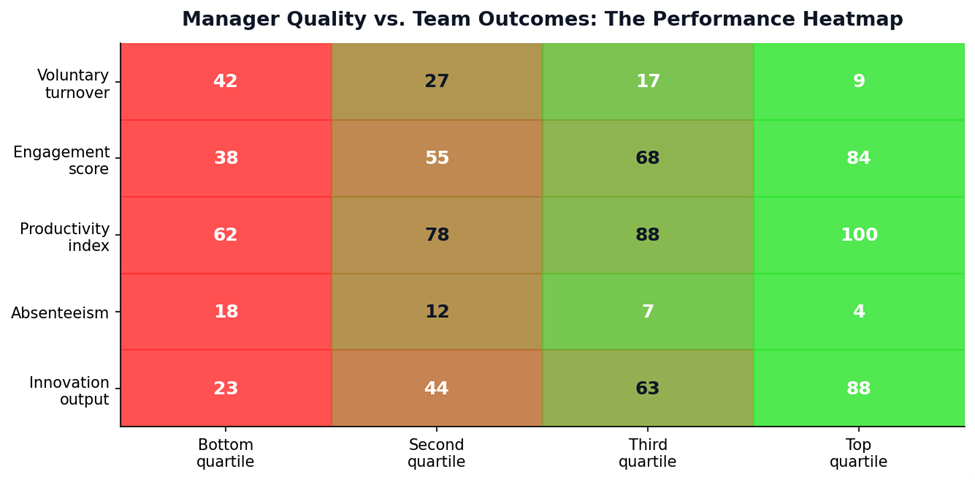
Manager quality vs. team outcomes. The difference between top and bottom quartile managers on voluntary turnover alone — 9% vs. 42% — represents millions in avoidable replacement cost. Source: Gallup, Business Infomatics analysis.
What the Difference Between a Good Manager and a Poor One Actually Costs
The Replacement Cost That Doesn't Appear on Any Budget Line
The cost of replacing an employee who leaves because of a poor management relationship is typically calculated as a recruitment cost. The recruitment agency fee, the interview time, the onboarding programme cost. This calculation captures approximately 20 to 25 percent of the real cost. The largest component — the productivity loss during the period between an employee deciding to leave and actually leaving, the performance gap of the new hire during a ramp period that typically runs six to twelve months, the institutional knowledge that departed with the previous employee, and the morale effect on the remaining team members who observed the departure and updated their own probability of staying — does not appear in any standard cost tracking because it is distributed across time and across teams in ways that the usual accounting creates no mechanism to see.
The research estimates for total replacement cost range from 50 to 200 percent of annual salary depending on the seniority and specialisation of the role. For a mid-level professional earning eighty thousand dollars annually, the total cost of departure and replacement runs between forty and one hundred and sixty thousand dollars. For a senior technical or commercial role, the upper end of that range is a conservative estimate. Multiplied across the portion of an organisation's voluntary turnover that is attributable to management quality — conservatively estimated at 40 to 50 percent of the total — the annual cost of bad management is a number that would justify substantial investment in the alternative.
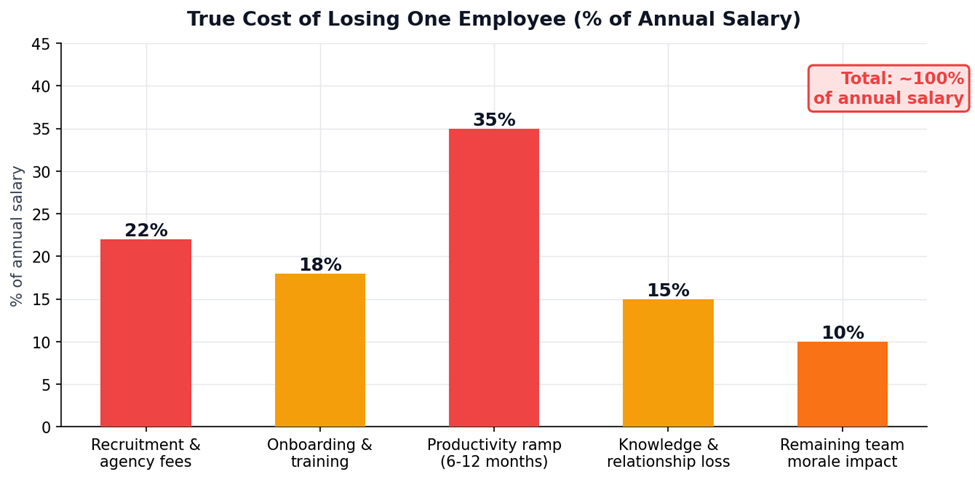
True cost of losing one employee, broken down by cost category as a percentage of annual salary. Total cost: approximately 100% of annual salary for a mid-level professional role. Source: SHRM, Deloitte composite.
The Performance Gap That Bad Management Creates While People Are Still There
Voluntary departure is the most visible cost of bad management. It is not the largest one. Gallup's engagement research consistently finds that the majority of employees in most organisations are not actively disengaged but are 'not engaged' — present, doing what is required, but not investing the discretionary effort that characterises high performance. The difference between an engaged employee and a not-engaged employee in the same role at the same organisation is, by Gallup's estimate, approximately 23 percent in productivity. The difference between an engaged employee and an actively disengaged one is larger still.
The variable that explains the largest share of the difference between engaged and not-engaged employees, in every large-scale study that has attempted to isolate it, is the quality of the relationship with the direct manager. Not company culture in the abstract. Not compensation level. Not the organisation's mission statement. The specific person who gives this employee their work, provides feedback on how they are doing, advocates for their development, and either creates or destroys the conditions in which good work feels possible. The organisation's culture is, in practice, the sum of the manager relationships it contains — and an organisation-wide engagement initiative that does not address the specific managers whose teams are the least engaged will consistently produce survey data improvement that does not translate into performance improvement.
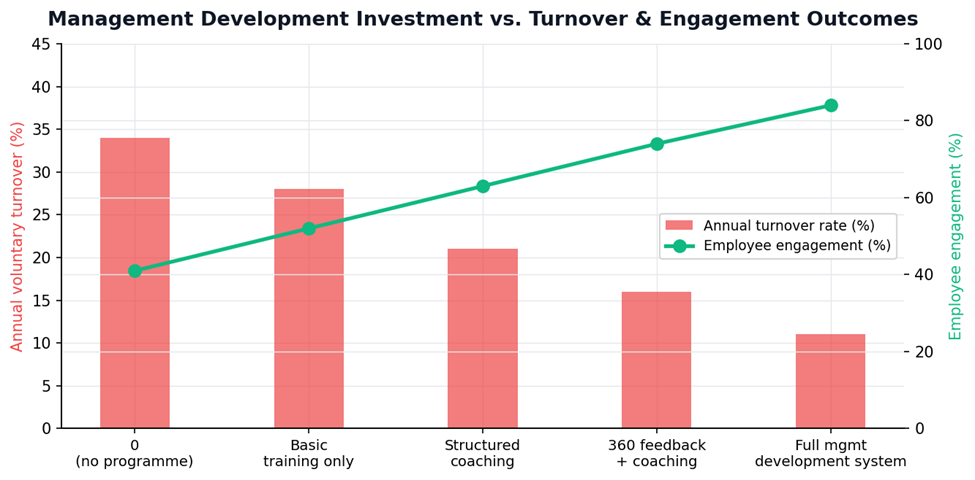
Management development investment vs. turnover and engagement outcomes. Moving from no programme to full management development cuts annual turnover by 68% while nearly doubling engagement scores. Source: Business Infomatics analysis, Korn Ferry benchmarks.
Why Organisations Keep Not Fixing This
The persistence of bad management in organisations that are aware of the problem and have significant financial incentive to address it requires an explanation. Several structural factors contribute. The most significant is the selection mechanism for management roles. In most organisations, high individual contributors are promoted into management as a reward for their individual performance — without any systematic assessment of whether they have the capability to do the management job, which requires an entirely different skill set from the individual contributor job. The best engineer is not usually the best engineering manager. The best salesperson is rarely the best sales manager. But the promotion model continues to produce managers who were selected for the wrong criteria and are then surprised to find that the things that made them successful as individuals do not transfer to their new role.
The second structural factor is measurement. Most organisations measure management quality on an annual cycle, through engagement surveys and performance reviews that aggregate to function or department level in ways that make it difficult to attribute outcomes to specific managers. A manager whose team has high turnover in a function where turnover is generally high looks the same in the data as a manager in the same function whose team is stable. The organisations that have improved management quality at scale have typically made manager-level measurement the foundation — tracking team-level engagement, retention, performance, and absenteeism by direct manager in a way that makes the variation visible and creates accountability for it.
What Serious Investment in Management Quality Actually Looks Like
The evidence on what moves management capability at the population level — not just for the exceptional managers who would have been good regardless — points consistently toward a few practices that most organisations implement poorly or not at all. Manager selection criteria that include genuine assessment of coaching and communication capability, not just technical or commercial excellence. Structured onboarding for new managers that provides practical skill development in the specific capabilities that distinguish effective management in your context. Ongoing coaching for managers — not the annual performance review but regular, specific, actionable input on observable management behaviours. And measurement that makes the outcomes of management quality visible enough that improving it becomes a strategic priority rather than a nice-to-have in the HR budget.
The investment required to build these practices is modest relative to the turnover costs they would prevent. A rigorous management development programme for a one-thousand-person organisation — covering selection, onboarding, ongoing coaching, and measurement — runs between two hundred and five hundred thousand dollars annually in programme cost and internal time. The annual turnover cost attributable to management quality in the same organisation is typically ten to twenty times that figure. The gap between the investment and the return is not a reason to feel good about inaction. It is a reason to ask why the investment has not been made.
The organisations that are building genuine competitive advantage through their workforce in the current environment are not doing something exotic. They are doing the work of management well — selecting for the capability, developing it deliberately, measuring it honestly, and treating the quality of the manager relationship as the human infrastructure on which everything else depends. That infrastructure is not expensive to build relative to what it costs to ignore. It is just harder to see on a balance sheet.