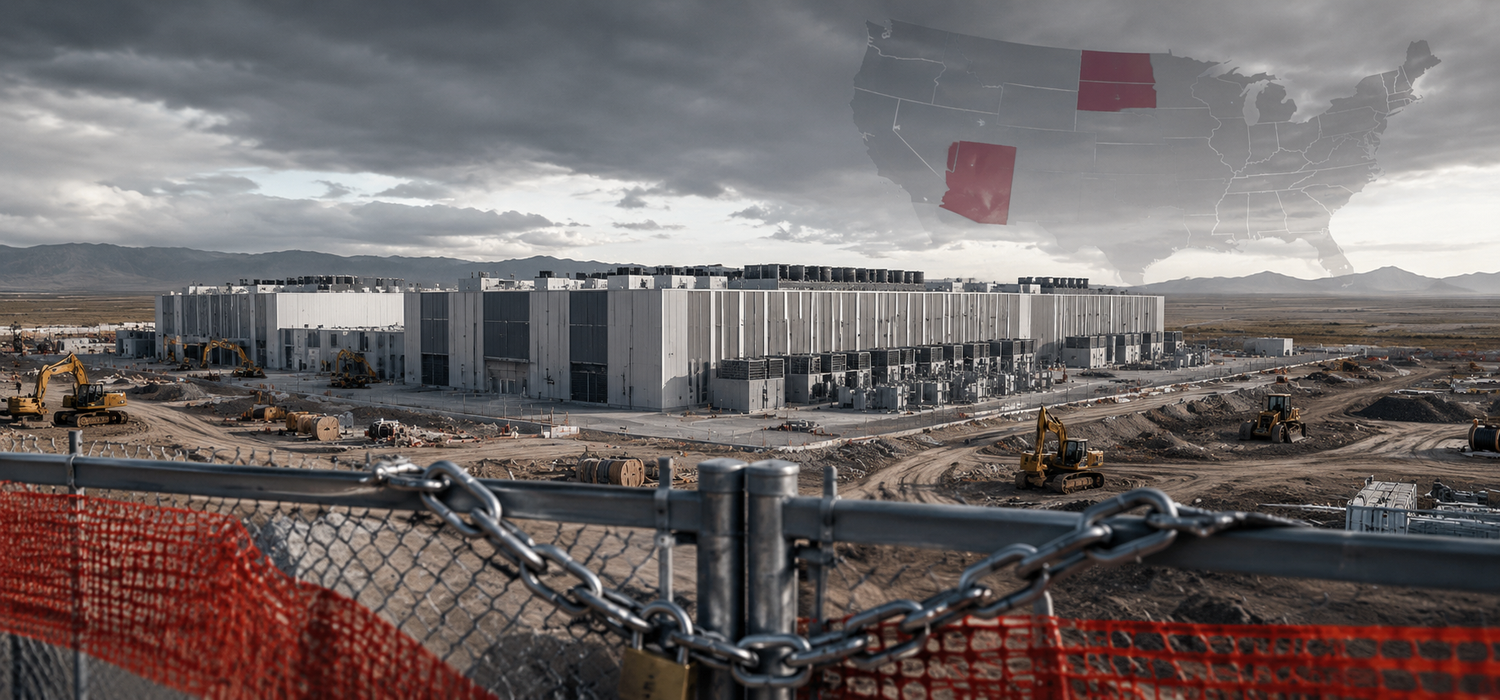
New York's moratorium has no end date. Texas is auditing an interconnection queue five times the size of its record peak demand. Your 2027 capacity plan now depends on a permitting process, and nobody on your team knows how one works.
We have argued in this publication before that power is the binding constraint on cloud capacity. That was an engineering observation. Over the past five weeks it became a political one, and political constraints behave differently: they do not respond to money, they do not follow a curve you can extrapolate, and they can arrive without a resolution date.
New York stopped taking applications
On July 14, Governor Hochul signed Executive Order No. 62, directing the Department of Environmental Conservation to hold in abeyance all pending data center permit applications. It is the first statewide data-center moratorium in the United States.
The trigger was roughly 12 GW sitting in New York's interconnection queue. The order remains in effect until the Department of Public Service submits its final generic environmental impact statement.
That last clause is the operative one, and it is easy to skim past. The order has no end date. A moratorium that expires in March is a delay you can plan around. A moratorium contingent on the completion of an environmental study — a document with no statutory deadline, subject to comment periods and revision — is something else. It is an indefinite option held by the state over every project in the queue.
Texas is counting, and the count is strange
Texas took a different route to a similar place. In early August, Governor Abbott ordered an audit of the interconnection queue, and ERCOT delayed its Batch Zero transmission planning study.
The number that prompted it: approximately 474 GW of interconnection requests, around 90 percent of them data centers — described in the state's own framing as more than five times Texas's record peak demand.
Pause on that figure, because it tells you something the coverage has mostly missed. Nobody believes 474 GW of data centers are going to be built in Texas. The queue is not a pipeline; it is a pile of options. The same project applies in multiple locations to preserve optionality, speculative developers file to hold a position, and requests that will never be financed sit alongside ones that will.
Which means the queue — the primary instrument utilities and states use to forecast demand — has stopped functioning as a forecast. That is the real finding, and it is why an audit was inevitable regardless of politics.
The audit's stated criteria are worth reading as a signal about terms of trade. It examines whether projects bring their own power, whether they bring their own water, and what state and local subsidy they receive. Cheap power was the location strategy for a decade. Those three questions describe a negotiation, not an incentive program.
Meanwhile, the spending assumes none of this
Set the two states against what the buyers of that capacity are telling their investors.
Microsoft guided to approximately $190 billion of capital spending in calendar 2026, up about 61 percent year over year. Its FQ3 capital expenditure including finance leases was $31.9 billion, up 49 percent, with FQ4 guided above $40 billion. Azure grew 40 percent; the AI business is at a $37 billion annual run rate, up 123 percent. CFO Amy Hood said the company expects to be capacity-constrained at least through 2026 — and attributed $25 billion of the capex figure purely to higher memory and storage component prices, which is the cleanest available datapoint on hardware inflation.
Gartner, for its part, has revised its 2026 IT spending forecast upward four times in ten months — 9.8 percent last October, 10.8 percent in February, 13.5 percent in April, 14.2 percent in July, reaching $6.37 trillion. Within it, data center systems grow 62.5 percent to $822 billion while services grow 5.3 percent. John-David Lovelock's description — "the largest infrastructure project ever attempted by humanity" — is doing a lot of work in a sentence.
A forecast revised up four times while two states apply brakes is not a contradiction resolved in the forecast's favor. It is a divergence between a demand curve and a physical delivery constraint, and only one of those two can be right about 2027.
Visual 1 — What changed, and what it does to a 2027 plan
Development | Date | Consequence for enterprise capacity planning |
|---|---|---|
New York EO 62 — permits held in abeyance | July 14, 2026 | No decision date. Any provider capacity dependent on new NY sites has an unbounded timeline, not a delayed one. |
Texas queue audit; ERCOT study delayed | Early August 2026 | ERCOT was the default overflow region. Its planning process is now paused pending an audit with no stated duration. |
Audit criteria: own power, own water, subsidy received | August 2026 | Siting economics are being renegotiated. Assume future capacity in these regions costs more, not the same. |
Microsoft: capacity-constrained through 2026 | Guided April 2026 | The constraint is acknowledged by the largest buyer. Reserved-capacity conversations get harder, not easier. |
Gartner: data center systems +62.5%, services +5.3% | July 27, 2026 | Budget is moving from people to iron across the market — including, probably, yours. |
How to read it: None of these individually breaks a plan. Together they mean that the availability of 2027 capacity in two of the most important US regions is now determined by processes with no published timeline — which is a different kind of risk from the one procurement is set up to price.
The question your provider probably cannot answer
Here is the practical test, and it is worth putting in writing to your account team rather than raising on a call.
Of the capacity you have been told will be available to us in 2027, what share depends on sites currently in the New York or ERCOT interconnection queues?
Most enterprises have never asked a regional-exposure question of a cloud provider, because there was never a reason to — capacity was fungible and the provider absorbed the siting problem. That assumption held for fifteen years and is the thing that just changed. Providers may decline to answer on commercial grounds, which is itself informative; a provider with no exposure has every incentive to say so.
A figure to avoidAggregate 2026 hyperscaler capital spending is widely quoted at $690 billion or $725 billion. Neither figure appears in any of the four major companies' filings — both trace only to secondary blogs and analyst aggregation. Microsoft's ~$190 billion guidance is company-sourced and citable. The aggregate is not, and using it in a board paper invites a question you cannot answer.
What to do now
Ask for regional exposure in writing, and put it in the renewal. A commitment to capacity is only as good as the site that delivers it. If your provider will not attribute capacity to regions, price that opacity into the term.
Add a permitting clause to capacity commitments. Contracts routinely cover outages and performance. Almost none address what happens if promised capacity does not materialize because a state paused permitting. That is now a foreseeable event, which changes how a lawyer should treat it.
Treat region selection as a regulatory decision, not a latency one. Latency, data residency and cost have driven region choice. Add a fourth criterion: how exposed is this region's expansion to a permitting process, and what is that process's track record on timelines.
Re-plan on longer lead times and stop treating headroom as free. Organizations that have run lean on reserved capacity because it was always available on demand are carrying an assumption that two states have now made questionable.
Watch for the GEIS submission. New York's moratorium lifts when the Department of Public Service files its final generic environmental impact statement. That filing is the single most informative signal available on when the freeze ends, and it will be reported nowhere near as loudly as the moratorium was.
For fifteen years, enterprise infrastructure planning could treat physical capacity as somebody else's problem — you bought a service, and the difficulty of building the building was priced into it and otherwise invisible. Two governors made that abstraction leak in five weeks. The uncomfortable part is not that capacity got harder to obtain. It is that the constraint now lives in a process your organization has no relationship with, no visibility into, and no ability to accelerate.
Sources and method. A BusinessInfomatics original. New York Executive Order No. 62, signed July 14, 2026, directing the Department of Environmental Conservation to hold pending data center permit applications in abeyance until the Department of Public Service submits its final generic environmental impact statement, per Sheppard Mullin; approximately 12 GW in the New York interconnection queue. Texas interconnection queue figures (~474 GW, ~90 percent data centers, described as more than five times record peak demand), the governor's audit and its criteria, and ERCOT's delay to its Batch Zero transmission planning study, per Utility Dive, August 3–5, 2026. Microsoft capital expenditure guidance, Azure and AI run-rate figures, the capacity-constrained statement and the $25 billion component-price attribution are from company guidance and earnings materials as reported in July 2026; see Microsoft investor relations. Gartner's 2026 IT spending forecast, its revision history and segment breakdown per Gartner, July 27, 2026 — a forecast, not a measurement. Aggregate hyperscaler capex figures circulating at $690bn and $725bn could not be traced to any company filing and are not used here.