
AI made entry-level work look optional, so companies quietly cut it. The cost doesn't show up now. It shows up when the senior bench you stopped filling runs dry.
The decision rarely gets made out loud. No one calls a meeting to announce the end of junior hiring. It happens as a series of reasonable-sounding individual choices: this role, the one a graduate used to grow into, can mostly be done by a model now, so we'll skip the backfill. Repeat that across a few hundred decisions and you've restructured your workforce without ever deciding to.
The data has caught up to the pattern. A Harvard study published in February found that at firms adopting generative AI, junior employment fell 9 to 10% while senior employment held steady. US entry-level job postings are down roughly 35% over eighteen months, and unemployment among recent college graduates has climbed to levels not seen in over a decade. The bottom rung of the ladder is being sawn off, quietly, one unfilled requisition at a time.
On this quarter's P&L, it reads as efficiency. Fewer salaries, same output, the model absorbing the work a junior used to do. The problem is that the cost of this decision is real but deferred, and deferred costs are the ones organizations are worst at pricing.
Where seniors actually come from
A senior employee is not a hiring category. It's an output — the end product of years of doing the unglamorous work, making the small mistakes, absorbing how the business actually operates. The junior analyst who builds the model wrong three times is how you eventually get the senior analyst who knows instantly why a number looks off. That judgment isn't downloadable. It's accumulated.
When you stop hiring juniors, you don't just save a salary. You stop running the only process you have for manufacturing future seniors. The pipeline that turns a graduate into a principal in seven years has no shortcut, and AI doesn't provide one — a model can do a junior's tasks, but it can't have a junior's career. Cut the intake and the shortage doesn't appear immediately. It appears in five years, as a hole in the middle of your org chart that no amount of recruiting budget can fill, because everyone is trying to hire from the same drained pool at once.
You can automate a junior's tasks. You cannot automate the decade of doing those tasks that produces a senior. Skip the first and you've quietly cancelled the second.
Visual 1 — The missing first rung
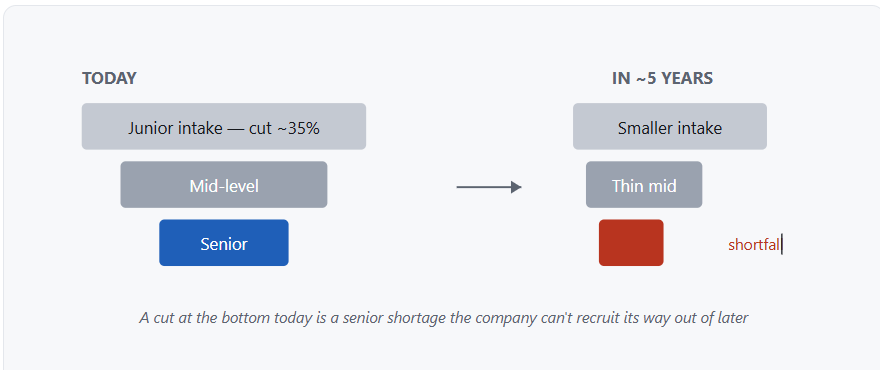
Conceptual model. The senior tier is a lagging function of junior intake years earlier. Reductions today are invisible until the cohort that should have advanced simply isn't there.
The contrarian wrinkle: it might not even be AI
Here's the part that should unsettle anyone confident they've diagnosed this correctly. A May 2026 working paper from researchers at Warwick, the LSE, and Oxford's Ellison Institute argues that the standard evidence blaming AI for the junior-hiring collapse may be confounded — that the permanent shift to hybrid and remote work is doing a lot of the damage we've been attributing to automation.
The logic is plausible and awkward. Junior employees learn by proximity — overhearing, shadowing, being corrected in the moment. Strip that out with distributed work and the junior hire becomes genuinely harder to develop, so firms hire fewer of them and tell themselves it's because AI made the role redundant. If that's even partly right, then companies are using AI as the socially acceptable explanation for a problem they created with their workplace model — and "fixing" it by leaning harder on AI will make it worse, not better. The honest version is that we're not sure which lever is doing the cutting, and acting as if we are is how you optimize confidently in the wrong direction.
What this means for leaders
Reframe junior roles as pipeline, not headcount. A junior hire is a multi-year investment in your future senior bench, and it should be evaluated on that horizon — not on whether a model could do this year's tasks more cheaply. The ROI shows up in year five, which is exactly why the annual budget process keeps killing it.
Redesign the role instead of deleting it. If AI does the work a junior used to learn on, the entry-level job has to change — toward judgment, oversight, and the messy human parts of the business — not disappear. The bar rises; the rung shouldn't vanish. Companies that figure out what a junior now does alongside AI will own the talent market in a decade.
Interrogate your own cause. Before you credit AI with your hiring cuts, ask whether your remote-work model is quietly making juniors harder to develop. The two diagnoses point to opposite fixes, and getting it wrong is expensive in a way you won't feel until the bench is empty.
The companies that win the next cycle won't be the ones that cut the deepest now. They'll be the ones that kept building the bench while everyone else was congratulating themselves on the savings — and then found, when the seniors were needed, that they were the only ones who still had any.
A BusinessInfomatics original. Drawn from the Harvard 2026 study on generative AI and junior employment, Revelio Labs and WEF data on entry-level postings, and the May 2026 Warwick/LSE/Oxford working paper on remote work as a confounding factor.