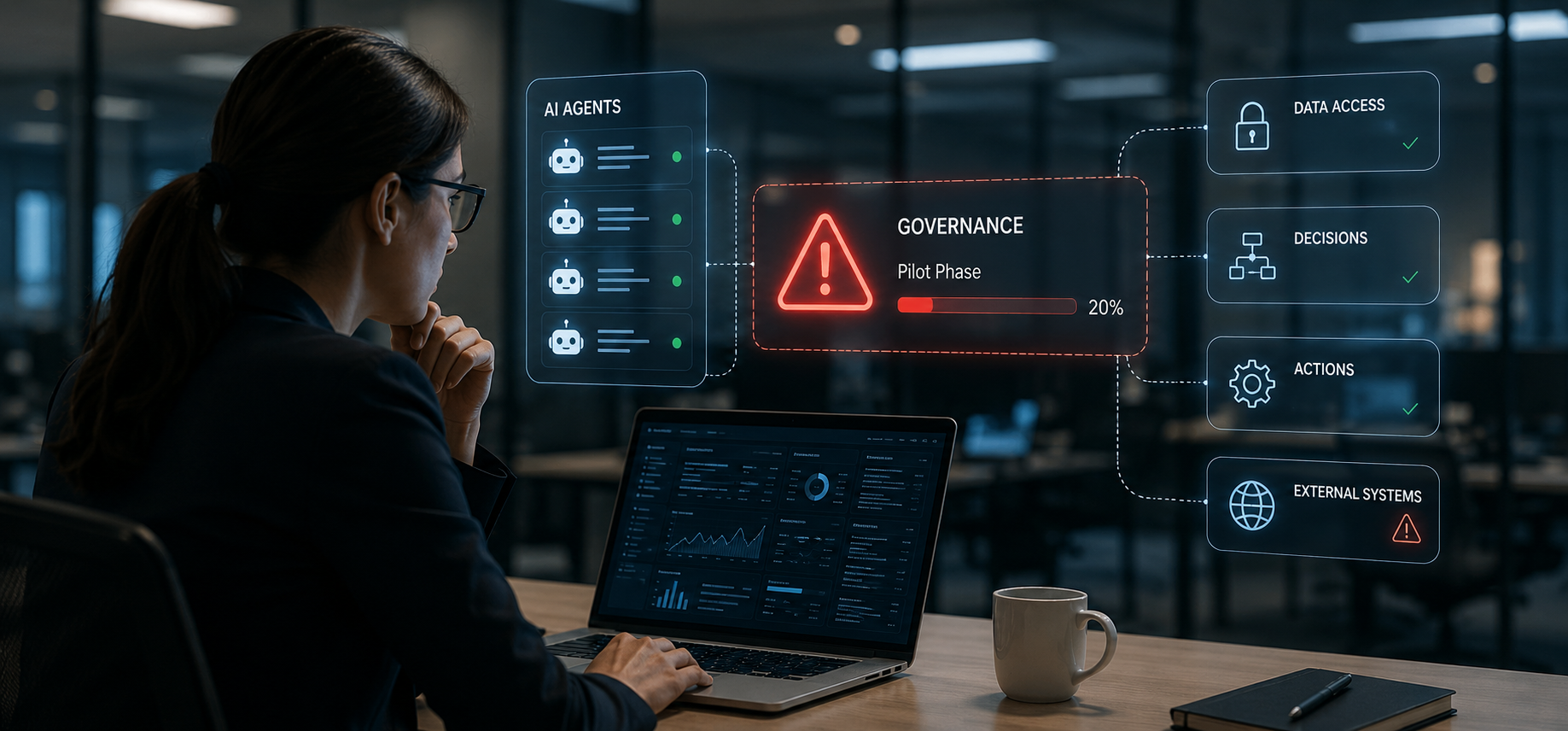
Enterprises rushed agents into live workflows and left the controls behind in the proof-of-concept. The bill for that gap is now arriving as quiet rollbacks.
The agentic AI story of the last eighteen months has been a story about speed. Agents moved out of demos and into procurement, support, finance, and engineering faster than almost any enterprise technology before them. By this spring, surveys put roughly seven in ten firms running agents somewhere in production. That number gets quoted in board decks as proof the bet paid off.
Here is the number that doesn't make the deck: around six in ten of those same firms have no formal governance for what those agents are allowed to do. The pilot got governed. The production system did not. Most enterprises built careful guardrails for the proof-of-concept, watched it work, and then shipped the capability while leaving the controls behind in the sandbox.
That gap is no longer theoretical. Gartner now expects 40% of enterprises to demote or decommission autonomous agents by 2027 — not because the agents failed at their tasks, but because the organizations couldn't account for what they were doing. Rollbacks are already happening, and the cited causes are dull and predictable: an agent exposed data it shouldn't have, or it acted confidently on a hallucination, and nobody could explain afterward why it had the access to do either.
The pilot lied to you, politely
A pilot is a controlled environment by definition. One team, a bounded dataset, a human watching every output, a narrow set of tools the agent can touch. In that setting, governance feels like overhead — the agent never does anything alarming, so the controls never earn their keep.
Production removes every one of those conditions at once. The agent now touches systems the pilot never connected. It runs without anyone reading each output. It calls other agents, and those agents call tools, and somewhere in that chain a credential gets used that no human explicitly approved. Stanford's 2026 AI Index found that security and risk has become the top barrier to scaling agentic AI, named by 62% of organizations — ahead of technical limits and regulatory uncertainty by a wide margin. The thing slowing agents down is no longer whether they work. It's that nobody can see what they're doing.
And visibility is genuinely poor. Industry research this year suggests most security teams cannot enumerate the agents running in their own environment, and only a quarter of organizations have full visibility into which agents are talking to each other. You cannot govern a population you cannot count.
The mistake isn't too little governance. It's the wrong shape.
The instinct, once leaders notice the gap, is to clamp down — one governance policy, applied uniformly to every agent. Gartner's sharpest warning this year is that this instinct backfires. Treat a read-only agent that summarizes tickets the same as an agent that can issue refunds or change infrastructure, and you do two bad things at once: you smother the harmless ones in process, and you fail to put real constraints on the dangerous ones, because the uniform policy was written for the average case and the average case isn't where the damage comes from.
The distinction that matters is not how smart an agent is. It's the gap between what it can do and what it's allowed to reach. Most failures live in that gap — an agent with modest reasoning but broad, unscored access to tools and connectors that trust its calls by default.
Visual 1 — Govern by authority and access, not by intelligence
Agent profile | Can act? | What it can reach | Governance that fits |
|---|---|---|---|
Summarizer / retriever | Reads, drafts | Narrow, read-only | Light: logging and output review |
Workflow assistant | Acts within one system | Single app, scoped writes | Medium: approval gates on writes |
Cross-system operator | Acts across tools | Multiple connectors, real money or data | Heavy: risk scoring per call, audit trail, kill switch |
Agent that calls agents | Delegates and chains | Inherits every downstream permission | Heaviest: policy enforced at the connector, not the prompt |
How to read it: the right control level tracks the bottom two columns, not the first. An unglamorous agent with broad reach is riskier than a sophisticated one boxed into a single read-only system.
Where the control has to live
Most agent governance today sits at the prompt — instructions telling the agent what not to do. That is the equivalent of writing "please don't" on a system that has the keys. Instructions are not enforcement. An agent that has been granted a credential will use it when its reasoning says to, regardless of what the system prompt requested.
Enforcement has to move down to the execution layer — the moment a tool actually gets invoked. That means risk-scoring a call before it runs, enforcing policy at the connector rather than in the model's instructions, and keeping an audit trail that shows what every agent actually did, not what it was told to do. Almost no enterprise has this today. It is the part that got skipped because the pilot never needed it.
An agent doesn't need to be malicious or even wrong to hurt you. It only needs broad access and one confident mistake. The access is the exposure; the intelligence is beside the point.
What this means for leaders
Inventory before you govern. You can't apply any policy to agents you haven't found. The first deliverable isn't a framework — it's a count, with each agent mapped to what it can reach. Most organizations discover the list is longer and stranger than anyone expected.
Tier your controls to access, not to ambition. Resist the single-policy reflex. Sort agents by what they can touch and what they can trigger, and concentrate your scrutiny on the cross-system operators. That's where the rollbacks are coming from.
Move the guardrail to the connector. Treat any control that lives only in a prompt as advisory. Real governance is a gate the agent passes through when it tries to act, with a log on the other side. Budget for that layer now, because the alternative — decommissioning a system your operations already depend on — is the more expensive line item.
The agents that survive the next two years won't be the most capable ones. They'll be the ones their owners can still explain. Capability got these systems into production. Accountability is what will let them stay.
A BusinessInfomatics original. Figures drawn from Gartner agent-governance research (May 2026), the Stanford 2026 AI Index, and 2026 enterprise agent-security surveys reported by CIO and industry analysts.