
Most enterprise AI deployments lack any systematic method for measuring whether they are delivering value. The absence of rigorous evaluation is the reason so many pilots never scale — and why some that do scale quietly underperform.
AI & Data · Business Infomatics Research Desk
The enterprise AI market is past the point where adoption decisions are primarily driven by the question of whether to deploy AI. The question now determining which organisations get real value from their AI investments — and which are accumulating expensive capability without commensurate return — is a measurement question: how do you know if it's working?
Usage metrics — active users, queries per week, documents processed — tell you something about adoption but nothing about value. Anecdotal endorsements from power users do not constitute evidence. The measurement infrastructure that would let an executive team answer the question with genuine confidence is absent in a majority of enterprise AI deployments.
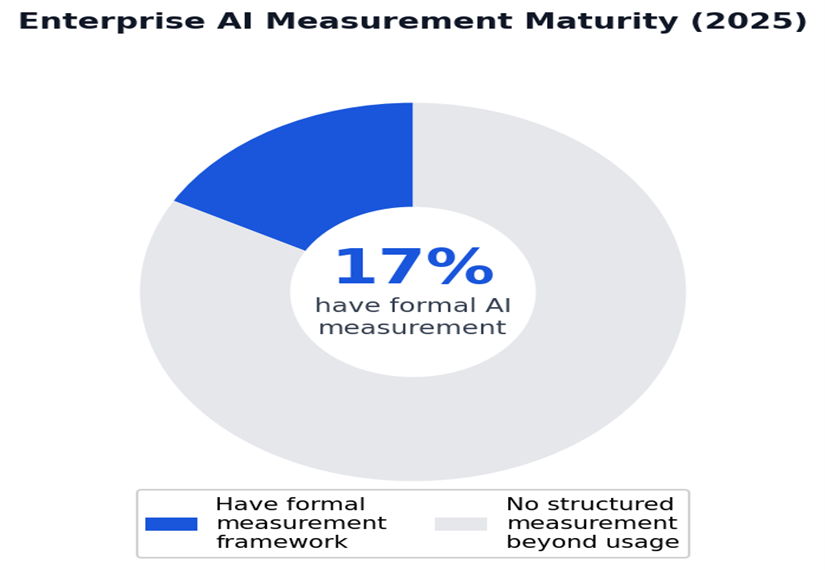
Only 17% of enterprises with AI in production have formal measurement frameworks assessing business outcomes. Source: McKinsey Global Survey on AI, 2025.
Only 17% of enterprises with AI in production have formal measurement frameworks assessing business outcomes beyond usage. (McKinsey, 2025)
Why Measurement Gets Deprioritised
Three patterns consistently explain why AI evaluation is underdeveloped relative to AI deployment. First, speed: AI deployment timelines are short but building a rigorous evaluation framework takes longer and requires different expertise. In organisations where deployment speed is treated as a proxy for strategic seriousness, the measurement framework gets deferred.
Second, internal politics. Rigorous evaluation creates the possibility of a negative result. For the teams who championed the deployment and vendors whose contracts depend on it, the incentive structure does not favour rigorous measurement. Third, genuine difficulty: attribution in complex organisational systems is hard. Isolating the AI contribution requires experimental design that most organisations either cannot execute or are not willing to accept the operational constraints of.
A Framework for AI Evaluation That Actually Works
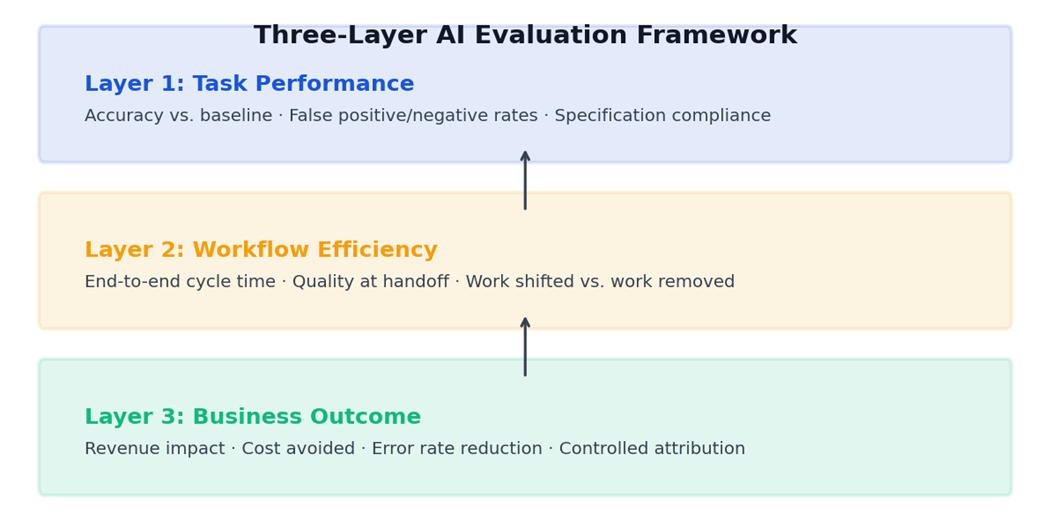
Three-layer AI evaluation framework: from task performance through workflow efficiency to business outcome attribution.
Layer 1: Task-Level Performance Metrics
The foundation of AI evaluation is measuring whether the AI performs the specific task it was deployed to perform, accurately, at the required level of quality. For a document review tool: accuracy rates against human expert review, false positive and false negative rates, and performance consistency across document types. For a customer service AI: resolution rates, escalation rates, and satisfaction scores compared to the equivalent human-handled interaction.
Layer 2: Workflow-Level Efficiency Measurement
The second layer measures whether AI-assisted workflows produce better outcomes than unassisted ones — accounting for all the ways AI can fail to deliver productivity at the workflow level even when task performance is strong. An AI that generates accurate first drafts but whose outputs require so much editing that total time investment is unchanged delivers task-level performance without workflow-level value.
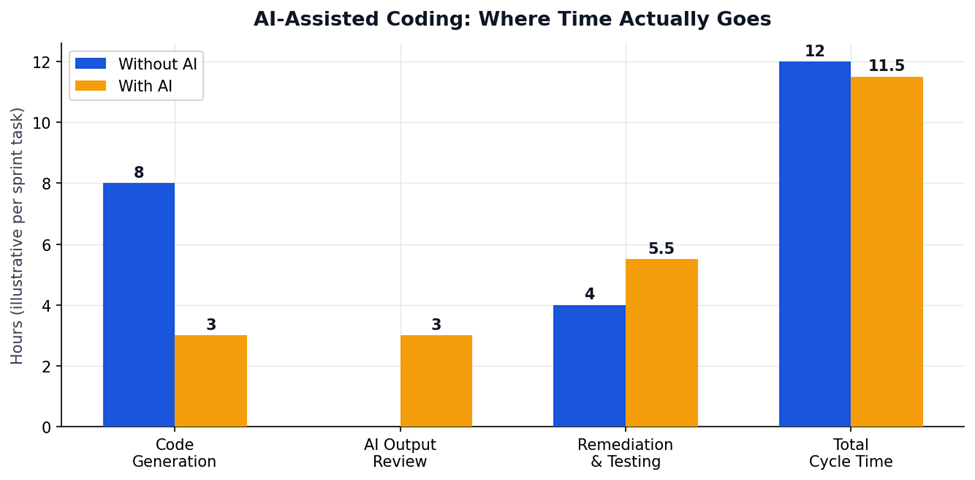
AI-assisted coding: where time actually goes. AI accelerates generation but adds review and remediation burden — total cycle time often unchanged. Source: DORA Report 2025.
43% of AI-assisted coding deployments show no measurable reduction in total engineering cycle time after accounting for review and remediation. (DORA, 2025)
Layer 3: Business Outcome Attribution
The evaluation layer that connects AI deployment to business results is the most contested and the most important. Revenue generated, costs avoided, error rates reduced — these are the outcomes that justify AI investment at the P&L level. Attributing them to AI requires a causal story and some evidence, not just a correlation between deployment timing and outcome movement. The most credible methodologies use controlled comparison — either geographical, functional, or temporal.
The Evaluation Infrastructure That Scales
Evaluating AI deployments rigorously at scale requires three components. First, instrumented AI environments that capture inputs, outputs, user actions, corrections, and downstream outcomes in structured, queryable form. Most AI tools generate some of this data; the question is whether it's being captured for evaluation rather than lost.
Second, explicit evaluation ownership. Who is responsible for producing evidence on AI performance, at what frequency, using what methodology, and reporting to whom? In the absence of explicit ownership, evaluation does not happen. Third, human review processes that generate ground truth labels — the structured expert review of AI outputs that makes many evaluation methodologies possible.
What to Do If You Haven't Started
The highest-value starting point is almost always the deployment with the largest claimed impact and the weakest evidence base for that claim. That is where the risk of misallocating future investment is greatest, and where rigorous evaluation is most likely to produce a decision-relevant finding.
The organisations that will get the most from AI are not those who deployed earliest or most broadly. They are the ones who built the measurement discipline to know what is working, at what cost, with what quality, and for whom. That discipline is learnable. It is not widespread yet — which means the organisations that build it now will make better AI investment decisions than their competitors for years.