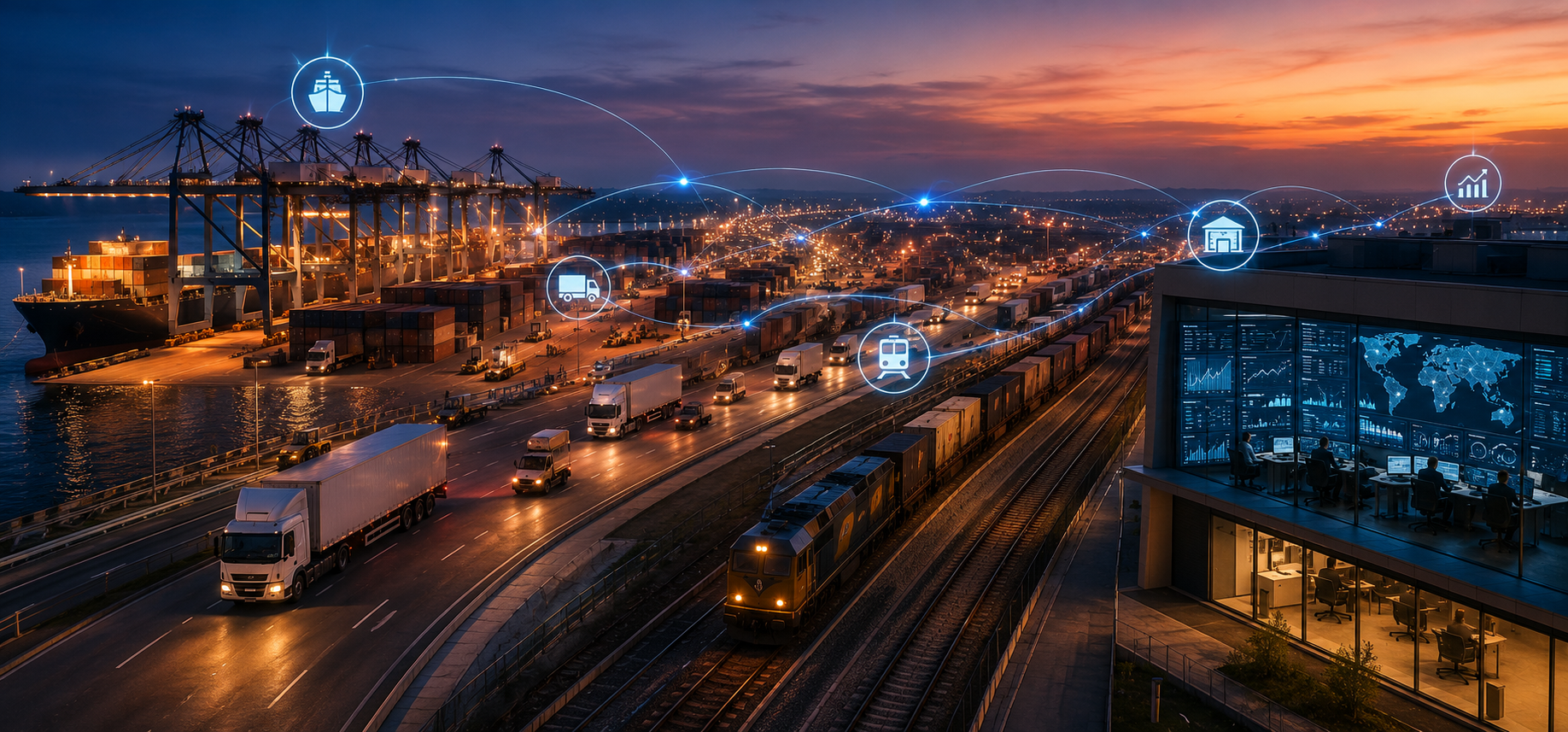
While most industries argue about whether agentic AI can handle real work, freight brokerage quietly pushed automation past 90%. It's the clearest live preview of what happens to a middleman business.
Most boardroom conversations about agentic AI are still hypothetical. Will it really handle the messy, exception-filled work? Can it be trusted without a human on every step? What happens to the people whose jobs it touches? These are reasonable questions, and most industries are debating them in the abstract. Freight isn't. Freight already ran the experiment, in production, at scale — and the results are sitting there for anyone willing to read a different industry's news.
Freight brokerage is, at its core, a coordination business: match a shipper who has freight with a carrier who has capacity, handle the quoting, tendering, and exception-resolution in between. It's exactly the kind of high-volume, communication-heavy work that looked human-proof and turned out to be the ideal target for AI. Large brokers now report roughly 30% productivity gains from generative AI handling thousands of emailed quotes and load tenders a day, and more advanced agentic deployments have pushed past 90% automation of the brokerage workflow. Not a pilot. The operating model.
Why freight got there first
Freight wasn't braver about AI than other industries. It was more desperate, and that's the more useful lesson. A three-year freight recession compressed margins to the point where efficiency wasn't a strategy choice but a survival one. When the business is bleeding, the abstract debate about whether to trust AI gets settled fast by the concrete question of whether you can afford not to.
The work also fit. Brokerage is repetitive, text-based, and pattern-rich — read an inbound email, price it against the market, find a carrier, handle the back-and-forth. That's a near-perfect match for what agentic systems do well, which is also why hitting 90% automation was possible here before it's possible in messier domains. The takeaway for other industries isn't "AI will automate 90% of everything." It's that wherever your work resembles freight brokerage — high-volume coordination, structured communication, thin margins — you're closer to the same outcome than the boardroom debate assumes.
Freight didn't adopt agentic AI because it was visionary. It adopted because a three-year recession made the alternative bankruptcy. Desperation, not vision, is what actually moves automation into production.
What happens to the middle
The most transferable finding is what automation does to a middleman. As AI absorbs the coordination work, the value migrates to whoever owns the platform and the network, and gets squeezed out of whoever was manually doing the matching. Digital freight platforms are positioned to dominate precisely because they can plug autonomous capacity straight into broad carrier networks; the small broker whose entire value was working the phones has nowhere to hide. The function doesn't disappear — it consolidates toward scale and software.
And the physical layer is moving in parallel, which compounds it. Driverless freight services on corridors like Dallas-to-Houston are now operational, with hybrid models emerging — autonomous on long-haul, human for first and last mile. So freight is automating both the coordination (brokerage) and the execution (driving) at once. Any business with a coordinating middle and a repetitive physical edge should watch this carefully, because it's the same two pressures arriving together.
Visual 1 — Read freight as a preview, not a niche
Freight characteristic | Why AI took it fast | Who else this describes |
|---|---|---|
High-volume coordination | Repetitive matching, ideal for agents | Insurance broking, staffing, wholesale distribution |
Structured communication | Email/quote patterns AI handles well | Procurement, claims, customer service |
Thin margins / recession | Survival forced adoption | Any sector under cost pressure now |
Middleman value | Squeezed; migrates to platforms | Agencies, distributors, intermediaries |
How to read it: the right column is the point. Freight isn't a special case — it's the first to hit conditions many coordination businesses will reach next.
The contrarian read: 90% is not 100%, and the gap is the business
It's tempting to take "90% automated" as "humans done." Freight's own experience argues against it. The automation clusters in the standard, high-volume flow; the remaining slice — genuine exceptions, relationship-sensitive accounts, the load that goes wrong at 2am — is where the hard value and the trust still live. The brokers thriving aren't the ones who automated everything. They're the ones who automated the routine 90% and redeployed scarce human judgment onto the 10% that actually decides whether a shipper stays. The lesson other industries should steal is not "replace people." It's "automate the volume, concentrate the humans where exceptions and relationships are" — and the firms that simply cut headcount to match the automation percentage tend to lose the accounts that lived in the 10%.
What this means for leaders
Stop debating in the abstract; find your nearest analog. If your work has freight-like traits — high-volume coordination, structured communication, thin margins — the question isn't whether agentic AI applies. It's how fast, and freight has already shown you the curve.
Assume the middle consolidates toward platforms. If your business is intermediation, automation tends to move value to whoever owns the network and software. Decide now whether you're building that platform or being disintermediated by one.
Reinvest the saved capacity, don't just bank it. The freight winners moved human effort to exceptions, relationships, and the moments that retain customers. Treating automation purely as a headcount cut captures the savings and loses the accounts that the 10% was quietly protecting.
Every industry is going to have its own version of this moment, and most are treating it as a future they get to deliberate. Freight is the one that already lived it — not because it was ahead of the curve, but because a brutal market wouldn't let it wait. The rest of the economy gets the rare gift of a worked example. The only mistake is assuming it's someone else's story.
A BusinessInfomatics original. Drawn from the 2026 State of Logistics Report, FreightWaves and FleetOwner reporting on AI automation in brokerage, and coverage of operational autonomous-trucking corridors.